Legal Hackette Lunches with Priscilla Coleman

Z-3Over kedgeree and a cool, crisp Gavi di Gavi at The Delauney, the country’s foremost court artist explains why she welcomes cameras in court even though it could put her out of a business, and reveals secrets from the trials of the rich and famous.

Texan-born Priscilla Coleman has had a ringside seat at the most high-profile and infamous cases of the last three decades.

Her oil pastels and water-based sticks have documented the trials of serial killers and celebrities, including Rosemary and Fred West, Ian Huntley and Maxine Carr, Barry George, Harold Shipman, Rolf Harris, Dave Lee Travis and Max Clifford.

The Wests, she recalls, didn’t look evil, just ‘ordinary’. Publicist Max Clifford, convicted of indecent assault under Operation Yewtree, she describes as ‘happy-go-lucky’. while DJ Dave Lee Travis, convicted in the same operation, teased her for making him look like Rolf Harris.

While fellow artist Harris, she says, was very friendly and even signed one of his books for her while he was in the court café. But, in the witness box, she says, he ‘could be pretty angry and bossy and looked quite fierce’.
Z
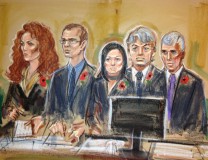
Image courtesy of Priscilla Coleman/MBA Media Solutions

In the phone hacking trial she compares Rebekah Brooks to Botticelli’s painting of the Birth of Venus, with her ‘high forehead, angel lips and mane of red hair like a Pre-Raphaelite model’.

Brooks, who was cleared of all charges, recalls Coleman, was ‘dignified, held herself tall and straight and was usually always controlled, except when she broke down in the witness box.’

Coleman witnessed part of the secret trial of Enrol Incedol, which she describes as ‘really weird’ and at the other end of the spectrum Gillian Taylforth’s unsuccessful libel case against The Sun, the Hutton inquiry and the inquests into the deaths in the July 7 bombings.

In her long career, those who have stood out include Christine Hamilton, wife of disgraced former Tory MP, Neil Hamilton. During his unsuccessful libel action against Mohamed Al-Fayed, Coleman recalls how ‘Christine Hamilton was shooting daggers the whole time at George Carman QC [who represented Fayed] and Al-Fayed’.

While she was charmed by supermodel Naomi Campbell, during her successful 2002 privacy action against Mirror Group Newspapers. ‘She was gorgeous – such a pretty girl, but she was really naughty’ airing her opinion of the newspaper’s barrister, Desmond Brown QC, in tones not so sotto voce that her views went unheard by those in court.

Beatles star Paul McCartney also won her over. Though the proceedings were closed to journalists, Coleman sat outside the court. McCartney and his ex-wife Heather Mills went in through separate doors, she recollects. ‘He walked through the door like a gentleman and greeted people, but he seemed very sad.’

While Mills, Coleman recalls ‘was a real contradiction and seemed happy with the attention, even though some of it was not very nice.’
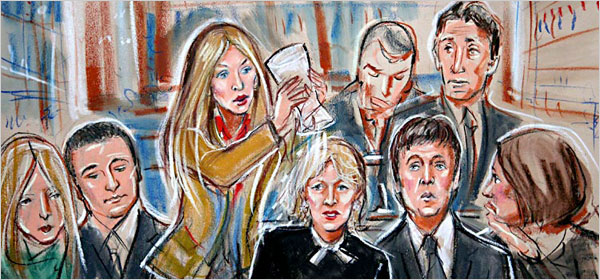
24heather.600
Image courtesy of Priscilla Coleman/MBA Media Solutions

After discovering what had gone on in court, Coleman produced this sketch of the moment Mills doused Macca’s solicitor, Fiona Shackleton, with a pitcher of water.

But it’s not all about the A-listers. ‘Judges and lawyers are fun to sketch and fun to listen too – they are always full of surprises’.

The late George Carman QC, who bought some of her pictures, she remembers especially. ‘He was mesmerising, flamboyant, naughty and always full of surprises.

‘He was a showman – similar to how lawyers behave in the States. It’s kinda frowned on now to be like that here, but it’s more entertaining’.

From the bar, Coleman also singles out the ‘charming’ Orlando Pownall QC and Courtenay Griffiths QC. Of the latter, she notes ‘he also has a little bit of an American style. And he charms jurors a lot. He’s really charming and that is so important as a barrister, particularly a criminal barrister’.
Z-1
Image courtesy of Priscilla Coleman/MBA Media Solutions

Having recently sketched the Hatton Garden robbers, she says how ‘nice and sweet’ the sentencing judge, His Honour Judge Kinch QC, was. ‘All the other judges were really jealous of him; they all wanted that case,’ she adds.

His Honour Judge Drake, who presided over several high profile defamation cases in the 1990s, she recalls with fondness. Attending an often crowded court 13, he would allow her to sit on the steps leading up to his dais.

‘Some judges are so strict it feels like torture, but when you meet them, they are often really nice,’ she says, adding that the clerks can be fiercer than the judges.

In 2013 Coleman made legal history becoming the first person in almost a century to be allowed to sketch inside the Supreme Court, despite the fact that filming has been permitted in the country’s highest court since 2009.

She studied fine arts and graphics at Sam Houston University in Texas and then worked for advertising agencies and a printing company, before getting into court sketching.

Coleman got her first gig when her college professor recommended her to cover a big case for the television news in Texas, because she liked to draw quickly.

‘Two police officers had thrown a Mexican guy who was really drunk and wearing army boots into the Buffalo Bayou. He drowned and they were charged with murder’.

Though initially she had little idea what to expect, after that case, she got the bug.

In her early years working in Texas, Coleman drew prisoners being given lethal injections, from accounts given to her by her cameraman and other witness, as she never attended an execution.

Married to an English banker, Coleman crossed the pond in the 1980s. ‘I had my tape with all my work on, but I didn’t know how things were done in this country. I went to ABC who told me that most of their graphics were done in New York and they didn’t need a court artist.

‘So I thought I’d go to the Old Bailey. There was a big trial there – a child abuse case where the parents had killed their little girl. A couple of reporters were outside doing a piece to camera. One looked a little bit grouchy, but the other, Simon Cole, who worked for ITN, looked friendly.

‘I spoke to him and he told me to go and see his news editor, who liked my work and sent me to cover another case at the Old Bailey.’

The second case she covered was the 1986 Jeffrey Archer libel trial. ‘It was just wonderful,’ she recalls, ‘so exciting’.

In the States you can go in to courts and draw at will, but doing so here is banned, due to a 1925 law – section 41 of the Criminal Justice Act to be precise.

Coleman learned that the hard way. ‘I had my notebook and I was doing little tiny drawings in the Archer libel case. Someone in the public gallery told the court clerk and I got in trouble for it. She took me out and said I could have been fined me’.

Coleman notes
Coleman’s notes

Taking out her notepad, Coleman explains how she works. ‘I take written notes – names, arrows, directions, colours. It’s like studying for a test and making things stick in my mind’.

Her shorthand aide memoir helps her draw at speed, which is crucial as she sometimes has as little as five minutes to complete a sketch in time for the news bulletins or print deadlines.

And her working environment can be hit and miss. While there are long tables in the corridors of the Royal Courts of Justice, she is often forced to sketch al fresco — in the car park at Belmarsh, where everyone is kicked out as soon as the court rises; on the grass outside Southwark Crown Court, and even on a bench in a graveyard.

‘There used to be a sofa in the ladies at the RCJ – I’d sit in there and work. PA’s (Press Association) room is pretty good, but they’ve got quite a big crowd in there and all the tables are taken.’

Coleman published a selection of sketches from some of the most famous cases, in a book, Court Scenes: The Court Art of Priscilla Coleman, written by the Evening Standard’s pre-eminent former court’s correspondent, Paul Cheston. The duo are set to publish a second volume later this year.

But capturing the scenes is not always easy. First off, getting a seat in court can be a scramble.

‘They make it so difficult for even me to go in. For the Adam Johnson trial I had to get up at 1am to stand in a queue, because it was first come first served for the tickets and there were only eight places’.

When she does get in, the views can be limited, because of where she has to sit, court furniture obstructing her view or security measures that restrict visibility.

She recollects a time at the Old Bailey, where she was supposed to sit in a position from where she could not see the defendants.

Coleman suggested she bring in a couple of bookshelves from home for her and the other two court artists to sit at, so they could see. She was given permission and brought in the shelves strapped together with gaffer tape.

‘When we weren’t there the solicitors used them. I thought they might be needed again, so I left them there. I think they’re still there — in court 12, I believe. And I’m missing two book cases.’

Public access to the courts, she bemoans, is getting worse. ‘It’s not because the courts are old – the modern courtrooms are worse than the old ones. The design of them is pretty bad’.

She is particularly annoyed by the changes made to several courts up north, where she complains that reflective glass has been used as a security measure to prevent members of the public from seeing the jury, resulting in observers being unable to see the person in the dock.

‘Somehow they have decided that the public are really dangerous and they don’t want them to see. They are afraid they will intimidate jurors.

‘So you only get a glimpse of defendants when they walk in and out, but that’s it – it’s pretty bad’.

On the positive side, she thinks that court 1 at the Old Bailey is ‘pretty good for general all round letting people see’.

She suggests courts should be built ‘on the model of a church where everyone can see the preacher’. At present, she says: ‘It’s like courts are kinda open, but not really’.

The increased use of cameras in court, she hopes will improve things. And she is pleased to have been asked for her opinion. ‘No one ever thinks to ask me about it when it’s being debated,’ she says.

Cameras have filmed the Supreme Court since 2009. Judgments from the Court of Appeal have been caught on camera since 2013 and a pilot filming judge’s sentencing remarks in six crown courts will begin soon.

‘I’ll be put out of business,’ she predicts, judging by the American experience where court artists have become ‘unusual and kinda rare’ due to televised hearings.

But she is concerned that filming must be done well. Good examples, she says, are the trial of Oscar Pistorius – ‘they got some pretty good shots there’ and the House of Commons, where ‘they have really worked at it and done a wonderful job – it’s beautiful.

‘If they could do it like that in the courts, they would be doing a really great job’.

Even in the States, where trials have been filmed for some time, Coleman notes ‘they get some really crummy camera angles’.

At other times, the technology can be too good. ‘I saw a trial on TV with subtitles instead of sound. I was told they couldn’t use the sound because it was too good and picked up all of the comments that the lawyers made to each other’.

A long-suffering aficionado of court IT, she makes a plea for the technology to be better than the kit used to relay hearings via videolinks into media annexes.

The quality of the video link in the hacking trial, she says was poor. ‘The screens showed fuzzy black and white images. You couldn’t even see one of the defendants and the sound was not good.

‘When you can get great shots on a mobile phone, I don’t understand why they couldn’t have done this better. It was a very important case. I guess it all comes down to money.’

Another gripe is the numerous rules about what she can and cannot portray – an art made harder by the fact that the rules are unwritten and inconsistent. ‘They make it so hard. I don’t know if they realise or care.’

The definite no-nos are that: you cannot show children; you can indicate their presence, but you cannot show the jury and, where identity is in issue, you can only show the back of a defendant’s head.

Other issues are a matter of taste. For instance, although she drew a picture of the bath tub exhibited in the trial of Ian Huntley and Maxine Carr in relation to the deaths of schoolgirls Holly Wells and Jessica Chapman, he did not publish it.

During that trial, the judge, Alan Moses ruled that no interactions between Carr and Huntley, that the jury might not have seen, could be depicted.

And during the trial of Barry George for the murder of TV presenter Jill Dando (his conviction for which was subsequently overturned), drawings had to be shown to the judge and barristers before publication and for while they were only permitted to depict three-quarters of his face.

While the pictures drawn during an Old Bailey trial of Real IRA members had to be oked by the defendants themselves. ‘Their barristers didn’t want them to be portrayed in a bad way, looked guilty, with a five o’clock shadow or a grouchy expression’.

With some frustration she harrumphs: ‘They never really go all the way and give you everything, yet the court proceedings are public and anyone can walk into a court and try to see what’s going on, providing there’s room’.

Therein lies another problem that she thinks cameras would solve – the lack of space in many courts for the press and public to attend. ‘In the trials that the public will want to see there will not be room for them to fit in the court.

‘A lot of times even reporters get stuck outside and have to rely on PA when their publication might want a different angle. Having cameras in court would solve that.’

She continues: ‘I would hate to prejudice a trial, but they should just get over it. If the judge and jury can hear and see something, let everyone.

‘You can’t keep a secret anymore with the internet and social media; people are always tweeting and gossiping’.

Coleman thinks cameras should bear all about what goes on in courts. ‘Just put it all out. Stop trying to be secret all the time; it’s not going to work.’

Legal Hackette Lunches with S Chelvan

Over pink champagne, fishcakes and shepherds pie at Inner Temple’s Pagasus Bar, the highest placed lawyer in the Indy’s The Independent on Sunday newpaper’s 2015 Rainbow List, LGBTI (lesbian, gay, bisexual, trans, intersex) activist and poster boy for the Joint Council for the Welfare of Immigrant’s ‘I’m an Immigrant’ campaign discusses the launch of a new group to promote LGBT+ issues at the bar, the need for greater visibility of gay judges and why heterosexual couples should be allowed to enter civil partnership.

High res Rainbowlist picIn a profession that in the eyes of many remains synonymous with pale, stale, conservative, public school chaps in dull suits, Chelvan stands out from the pack – loud and proud.
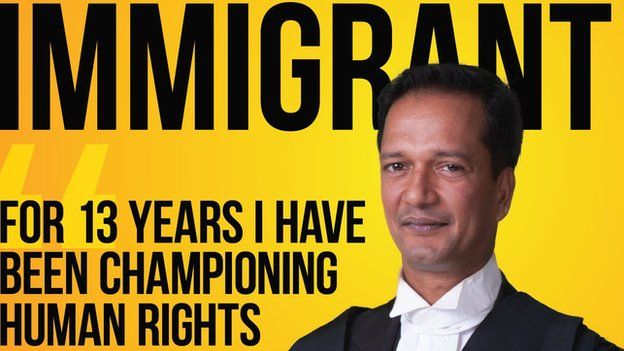
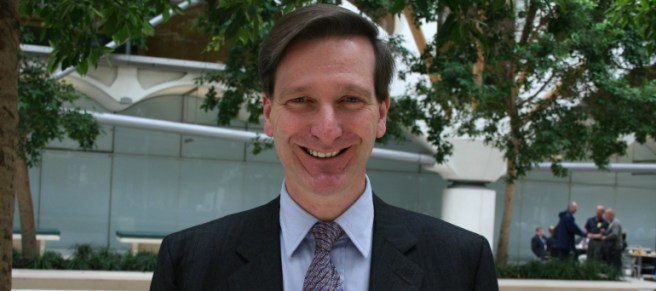
‘I will wear colourful shirts because it suits my complexion rather than dusky blue’, he states.

It is not just a sense of style that makes Chelvan stand out. In trendy parlance, he ‘self-identifies’ as a gay, black (international classification for non-white) Hindu, with a hearing difficulty – and if that doesn’t tick enough diversity boxes, he grew up in Worthing.

But first — an explanation of his name – his chamber’s website lists him as S Chelvan, but, as he explains, Chelvan is his ‘given’ name used to represent his last name, in accordance with Sri Lankan Tamil tradition. It is prefixed by the ‘S’, which is the first letter of his father’s last name.

He shares a modest room with two colleagues at No5 Chambers, tucked away off Fleet Street, far from its Birmingham ‘mother ship’.

Chelvan’s corner is super-organised, with bookcases bearing neatly filed cases, ordered on ascending shelves according to the tribunal level that each has reached.

Behind his desk a sketch by court artist Isobel Williams, done during his first case at the Supreme Court, AA (Somalia) v Entry Clearance Officer (Addis Ababa).  He was led by Manjit Gill QC in a case that challenged the lack of protection by the immigration rules in family reunion cases to cover non-biological children adopted by wider family members under the Islamic custom of kafala, often after a child has been orphaned.

Chelvan has developed an international reputation in asylum and immigration law, in particular in asylum claims based on sexual or gender identity. In many countries, he bemoans, ‘it is still dangerous to be gay’.

There are 80 countries in which consensual same-sex activity is a criminal offence, and it remains punishable by death in five countries.

As for the UK’s attitude to those fleeing persecution because of their sexual orientation, he recalls ‘the dark days of gay asylum law were 2004-10’. The Home Office operated a policy of ‘reasonable tolerable discretion’.

Where it accepted claimants were gay and would face persecution or death if returned to their home countries, it suggested they could avoid such threats by voluntarily exercising discretion and concealing their sexuality.

‘They could only get asylum if they proved that it was not reasonably tolerable to do so.’

A landmark judgment in July 2010 in HT (Cameroon) and HJ (Iran),  in the cases of two gay men, the Supreme Court unanimously ruled that the policy was wrong.

‘No-one would proceed on the basis that a straight man or woman could find it reasonably tolerable to conceal his or her sexual identity indefinitely to avoid suffering persecution,’ said Lord Rodger, delivering the lead judgment.

From there, the Home Office’s policy moved from one of discretion to disbelief, explains Chelvan. ‘Claimants would be asked degrading tick-box questions to prove their sexual orientation – such as did you wear a condom or did you ejaculate’.

The types of humiliating questions were revealed in a leaked Home Office document in 2014 in The Guardian.

To improve the process for determining the credibility of LGBTI asylum seekers and to make the interviews less like an interrogation, less judgmental and less intrusive, Chelvan developed a model of open-ended, non-adversarial questioning.

Its premise, is that there are several characteristics that are almost universal among LGBTI people that they will be able articulate – difference, stigma, shame and harm (DSSH).

He explains: ‘You realise you are different, you realise that difference sets you apart from the rest of society, which brings stigma and shame. And what makes you a refugee is that you face harm because of that difference’.

His model was endorsed by the UNHCR in 2012 and has been adopted around the world, which, says its creator, is ‘mind-boggling’.

‘The bar gives you the opportunity to do that, to change things – you are not just a litigator – you are taking a lead’.

Despite the strides made over recent years, says Chelvan, there is much still to do. To that end, he sits on two Home Office committees, advising on policy and helping ensure it complies with its international obligations and keeps in step with legal and other developments – although, he notes, it does not always heed his advice.

Immigration and asylum, he says, is ‘such a politicised area of law’ and the Home Office has a perpetual fear that people will abuse the system and too many article 8 – the right to family life — claims will be allowed.

The current moves to codify article 8, designed to restrict its application, he says, will serve only to increase the numbers of people forced to go underground and live in servitude, as the government is trumpeting its Modern Slavery Act.

The expanding lexicon of sexual identity, emerging in the population at large, is reflected in new asylum cases – moving from lesbian and gay to bisexual and, more recently, to address trans and intersex claims based on gender identity.

The latest buzz acronym – LGBTIQA – has the additions, he explains, of queer (Q) – either another word for gay, or questioning – and straight allies (A) – those who support and promote equal rights for the others.

If the world can still be an unsafe place to be an out LGBTI-er, what of the bar?

LGBTI campaigning charity Stonewall has just published its 12th Workplace Equality Index, which features a dozen law firms in its top 100 and at 13th, Simmons & Simmons, highlighted as a ‘Star Performer’ in recognition of its long-standing commitment to creating workplace equality.

Chelvan has been out since university and overtly so in practice – in his applications to chambers he was frank about his reasons for coming to the bar – ‘to change the law in relation to gay equality issues’.

Despite efforts made by groups including the InterLaw Diversity Forum and the Bar Lesbian And Gay Group, he says, prejudice remains and many do not feel safe to come out.

‘Only the other day I heard of someone taken on at a really right-on set, who only felt able to come out after completing pupillage,’ he says. ‘The bar should have been a safe place for them to feel able to be out from the start.’

He understands that for some, sexuality is private, but for others, ‘it’s not about coming out and making a statement that you are gay, but being able to tell your colleagues honestly what you did over the weekend and correctly identify the gender of your partner’.

‘We have an urgent crisis in relation to dealing with diversity, not just in relation to LGBT+ issues,’ he warns, citing the fact that England and Wales appointed only its second South Asian minority ethnic High Court judge last year.

‘We need to do something pretty quickly. I’m not patient enough to wait another 50 years – there are candidates with merit, but because of the message that is being sent out, they are not applying’.

To help hasten the change, Chelvan is involved in a new project to promote LGBT+ equality at the bar.

The forum – FreeBar – initiated by Matrix, Hardwicke, No5 Chambers, 5 Paper Buildings, 3 Hare Court and Stonewall, aims to work with chambers, employers and individuals, be they LGBT+ or straight allies, to promote inclusion and best practice and to celebrate LGBT+ role models and allies.

Its guiding principle is Stonewall’s tag line ‘acceptance without exception’.

‘We aim to work alongside other groups to ensure LGBT+ issues are at the forefront and people feel safe to be who they are in the workplace without discrimination or prejudice,’ says Chelvan.

The group officially launches on 17 February at an event hosted by City firm Travers Smith. For information about the forum and the launch, email info@freebar.co.uk.

Would he like to be a judge?

He can only think of two ‘out’ gay senior judges – Lord Justice Adrian Fulford and the Chancellor of the High Court, Sir Terence Etherton — and says: ‘Things would have to change in the judiciary before I’d feel it was a safe space to do that.’

He adds: ‘There are countless other people ahead of the queue who aren’t applying or getting selected. I want to see a change happening in visibility before I would even consider applying.’

In any event, he gets a ‘buzz’ from the work he is doing now – ‘advocating on behalf of your client’ – whether before the first tier tribunal, Court of Appeal or Supreme Court.

‘It’s not a job, it’s a vocation’, he says, noting that there are two types of barrister – ‘the first instance barrister, who just wants to go to court and win the case, and the appellate barrister, who wants to change the law.

‘I’m not here just to apply the law; I’m here to change it, to empower my clients and a larger pool of people.’

But changing the law can often takes years. ‘My mother used to tell me “God says three things – yes, no or later.” I’ve taken that as my litigation strategy. When the Court of Appeal says “no”, I think “ok, we’ll come back later”.

‘And I’ve found that to work. Sometimes you will lose, but at least you’ve put a mark in the sand that you can come back to later’.

Chelvan views his role as his clients’ legal interpreter. ‘Instead of translating their words from their mother tongue to English, I interpret the words from their narrative to the law.’

A cerebral chap, he regards the bar as being about ‘intellectual curiosity’.

‘One of my favourite philosophers, Francis Bacon, said “knowledge is power” and that applies to the law. If you know your case inside out it really does empower you.

‘I find the weakest point in my case and so long as I can address that, I can build my argument.’

Among the altruism and desire to change the world, inside the flamboyantly dressed advocate is, a bit of a show off.

‘One of my earliest memories is being asked to recite Goldilocks and the Three Bears when I was five years old at primary school.

What I loved about it was not just telling the story, but seeing my friends watching me and listening – and that’s the thrill you get as an advocate. It’s not just speaking; it’s the fact that people listen to you.’

‘I’m living the dream; this is my dream job,’ he says, quickly adding ‘though not the money; the money is horrific.’

Predominantly a legal aid lawyer, he says: ‘Every time there are legal aid cuts I worry about money and about my age debt and paying the bills, but I can’t think of doing anything else.’

He has started doing public access work, taking LGBTI asylum claims from application. ‘That’s been a wonderful insight about the part of the process I hadn’t known about. And it pays, thank God.

‘But, I’m still a jobbing legal aid lawyer and will continue to be a legal aid lawyer because the majority of my clients don’t have any money – they have lost everything’.

He and his junior are even taking one Court of Appeal case on a conditional fee arrangement.

Hailing the importance of the solicitor-barrister relationship, he says: ‘I’m very lucky to work with solicitors who, even with ridiculous slashing of legal aid, will go above and beyond the call of duty for their clients’.

During his pupillage, which he completed at Doughty Street and Garden Court, he went to Harvard to do a masters degree as a Kennedy Memorial Trust Scholar, after which US law firm opportunities arose.

He rejected the possibility of a $120,000-a-year gig to come back to the UK and be a legal aid lawyer.

He has no regrets about the decision. ‘I do the same hours as my friends across the pond, but I don’t have two apartments overlooking Battery Park’.

On the flip side: ‘My friends in the States are not doing work that they are passionate about and they don’t get cards saying “thank you for saving my life” – which is priceless’.

One of the reasons he his passionate about his clients cases is because he has experienced rejection and ostracism as a result of his sexuality, growing up knowing that he was different, but not being able to express it.

‘I realised I was different when I was a child. When my brother was seven, he had a birthday cake in the shape of a football pitch. When I was seven I had a cake in the shape of a number seven decorated with pale pistachio green icing with pink roses.

‘When he was nine, he had an R2D2 cake; I had a cake with pale blue icing and marzipan roses and butterflies. Did anyone think I was gay? No, but I wasn’t conforming to the hetero-normal narrative. Years before sexual awakening you realise you are different.’

Chelvan says he realised his sexual identity at 14. During his school years section 28 of the Local Government Act 1988 banned schools promoting homosexuality or teaching the ‘acceptability of homosexuality as a pretended family relationship’. Indeed, it was not repealed in England and Wales until November 2003.

‘I didn’t know about that law, but I knew there was something that I couldn’t speak to my English teacher about, but she guessed and recommended books for me, like those by Alice Walker. It was the first time I’d ever read about a same sex relationship and I was able to identify with someone.’

He led a ‘traumatic double life’, outwardly conforming to what was expected of him, but knowing inside he was different from that outward impression.

He came out to his family at 21. The following day his mother gave him an ultimatum – be celibate for five years and then they’d marry me off to some girl or leave the home.

‘So, I was kicked out of home. My stuff was sent in dustbin bags to my halls of residence and I received a letter via the family solicitors saying I was formally disowned.’

It was, he recalls, a ‘dark and difficult’ part of his life. But he had already come out to his friends at Southampton University, who were hugely supportive.

‘As Armistead Maupin says, you have two types of family – your biological family and your logical family. Thankfully, I definitely have my logical family who accept me and have always been there and who I love dearly’.

During his time at university, the age of consent for homosexuals was still 21, gay men and lesbians were banned from serving in the armed forces and there were no anti-discrimination laws.

‘I knew I wanted to do something to change my world.’ He even tried to get the armed forces excluded from the university’s careers fair.

_82188556_4d1e8178-1169-4a5b-9f67-2d0b4d8179ce

Born in Sri Lanka, Chelvan came to the UK when he was four. Being the eldest son, he was expected to follow his mother into the medical profession. But after doing work experience with a barrister when he was 14 he told his parents he wanted to become a barrister.

They suggested he qualify as a doctor and then switch to law. Ultimately he gained a first class degree politics and law and studied for the bar with a scholarship from Inner Temple.

Chelvan has achieved much success – he was voted barrister of the year in 2014 in the Legal Aid Practitioners’ Group’s Legal Aid Lawyer of the year awards and went straight in at position 43 out of the top 101 influential LGBTI individuals in the UK in the Independent’s Rainbow List (formerly the Pink List) last year.

At 41, he seems in a place where he is completely assured and comfortable in his skin. Such openness and honesty is unusual and appears to embolden and empower him.

Some may mistake his assuredness and tenacious advocacy for arrogance and he accepts: ‘I’m marmite – some members of the bar are not attracted to my personality and react negatively to me being overt and being who I am’.

But he is quick to pay tribute to those who have helped him, particularly his chambers and his ‘inner circle’, not least his husband, Mark, whom he describes as the ‘most wonderful man on the planet’.

They formed a civil partnership in 2006, and converted it to a marriage last year – both ceremonies taking place at Inner Temple –wearing Neru jackets embroidered with peacock feathers for the first (in Hinduism, peacocks symbolise immortality) and suits for the latter.

The extension of marriage to same-sex couples, ‘gave me goose bumps’ and he, says, he could not understand the opposition to it. ‘No one was forcing a straight person to get married to a person of the same sex. Just because I would have equality doesn’t discriminate against you’.

Making the upgrade was important to him as it gave him equality with heterosexual couples and removed the sense of ‘disenfranchisement’ he had felt.

‘When someone asks if we are married, we no long have to qualify the answer by saying “technically it’s a civil partnership”’.

He approves of extending civil partnerships to non-gay couples. ‘Equality is equality; you can’t redefine equality.’

What else does he want to do?

‘I want to have kids. I knew I wanted to be a dad before I knew I was gay. Mark and I hope to have kids one day through surrogacy – one fathering each. He will make the most amazing co-parent.’

Professionally, some might consider that a black silk jacket would be a deserved addition to his wardrobe.

Legal Hackette Lunches with Baroness Deech

Me 2015Over Chinese noodles in the House of Lords’ café, the blogging, tweeting, former chairman of the Bar Standards Board discusses divorce reform, disability discrimination, the demise of freedom of speech at universities – and, of course, legal regulation. 

Baroness Ruth Deech, former law fellow and Principal of St Anne’s College, Oxford, has had extensive experience of regulatory bodies, serving as chairman of the Human Fertilisation and Embryology Authority (1994-2001), a BBC governor (2002-2006), and as the first Independent Adjudicator for Higher Education (2004-2008).

In 2009 she was appointed chairman of the Bar Standards Board – a role she was to hold for six years, presiding over some of the most radical shake-ups to the bar.

She explains how she got the job after coming to the end of her time as adjudicator for higher education: ‘I was looking for a sort of portfolio part-time existence. I saw the [BSB] ad in the newspaper and I thought that looks boring and badly paid.

‘Then the ‘phone started going and all my legal friends started ringing up saying “Ruth, there’s a job. Nobody else wants it; it’s boring and it’s badly paid – you’ve got to do it.” I fall for that sort of thing, so I did it’.

But she reflects: ‘It wasn’t boring – sometimes very fraught, but never boring.

‘I felt it was very important and worthwhile, even though some of the barristers you had to deal with were a bit unwilling to be regulated’.

The former chair explains her two main aims during her tenure – to preserve the distinct nature of the bar through maintaining a separate regulator, and to cut through ‘the dreadful business jargon, unnecessary bureaucracy and interference’ in regulation.

The greatest achievements, she says, were ‘keeping the bar separate – we kept it from being crushed by the really rather ignorant Legal Services Board; we produced a new handbook, which was a mammoth undertaking; and we got alternative business structures done. We also managed to preserve the cab rank rule’.

‘Before I left, I looked back at the original business plan and we had achieved everything that was in it from reform of CPD to reform of pupillage’.

Deech is passionate about the importance of an independent bar, but rejects as ‘complete nonsense’ the accusation levelled at the BSB from some quarters, most notably the LSB, that the regulator was at times too close to the representative Bar Council.

‘We weren’t close to the bar. We were in the same building to save money. But if anyone thinks we were close to the bar, why would we have introduced QASA [Quality Assurance Scheme for Advocates], which the criminal bar practically went on strike about?’

And working to introduce QASA, despite strong opposition from the rank and file, she insists, was ‘the right thing to do’.

Every profession, she asserts, requires some form of feedback, appraisal and accountability. She was ‘baffled’ by the hostility to the scheme, which she says only ‘asks people to undergo a feedback regime every few years.’

‘I don’t really know what they were so upset about because I’m sure there are very few poor advocates. By the nature of the job you wouldn’t get very far if you weren’t good at it.’

She adds, if the complaints made by some at the bar about the inferior standard of solicitor advocates are right, QASA ought to help the bar. ‘If the solicitor advocates are really that bad, it would be a way of highlighting it and making them pull up their socks’.

In any event, she insists it was the LSB leading the charge for QASA as part of its ‘mechanical regulation model’, which was not tailored to the bar; rather a reflection of how it thought regulation is done.

‘Protector of the bar’

During her time at the BSB, Deech saw herself as a ‘protector of the bar, not for its own interest, but as the ‘real upholder of the rule of law’.

‘There is only one profession that will take any case that comes, under the cab rank rule, even if it’s for terrorists or against the government. Unless you have a cadre of people that are prepared to do that your legal system is not going to be fearless and you’re not going to have the rule of law’.

The reforms introduced under her watch, which included the first move towards ABSs, she insists, did not undermine the independent bar or create a slippery slope towards fusion.

Barristers, she insists, in whatever form they practise, ‘have a very strong sense of their own identity and their own mission’.

Deech, who is married to a solicitor, contrasts the two professions. ‘The solicitor’s ethos, as far as I can make out, is more business-like and about making money.

‘Some firms have ideas about what sort of work they’ll do – they’ll only do work for trade unions or whatever. So it’s a more limited range and it’s probably more dominated by overall earnings and marketing and so on.’

Adding swiftly: ‘I’m not saying that barristers aren’t interested in earning – you bet they are. But I think solicitors as a whole have more of that drive, while the individual barrister has something else to think about as well’ – defending the rule of law.

Praising barristers’ pro bono efforts Deech would like to see City law firms up their game, though she stresses it must not be seen as a way of filling the gap left by legal aid. ‘It’s the government’s job to fill the gap, not the solicitors’ firms’. And the proposed levy on City law firms to fund the justice system is ‘wrong’ she says, comparing it to getting doctors to fund A&E.

Bring back the old-style Lord Chancellor

‘It was a big mistake to have changed the role of Lord Chancellor,’ asserts Deech. Although it was a ‘strange role’ she observes: ‘The Lord Chancellor was both a judge, a member of the government and a legislator – somehow once in position and once they’d put on the wig and silk stockings and assumed one of the highest positions in the land, they turned into champions of justice and guardians of the courts’.

There is now nobody who serves that role, she bemoans. ‘There’s no one to champion at the highest level the rule of law and how justice is to work. That leaves a terrible gap in our government now. I regret very much the turning over of the job to lay people and to it becoming an ordinary ministerial post.’

She continues: ‘Mr Gove seems to “get it” more than Mr Grayling did. But the Lord Chancellor, even someone as intelligent as Mr Gove, is a politician – here to day, gone tomorrow and looking for the next job.’

She calls for a return to the ‘old-style Lord Chancellor’. ‘Only they have the overview of the court system, what’s going on and how it ought to be represented at Cabinet and fought for’.

The future of legal regulation

On this subject Deech is adamant, leaning in to the recording machine to ensure her views are captured: ‘I’d like to see the end of the LSB’.

She describes the Legal Services Act 2007, which created it, as the ‘worst Act I’ve ever seen, both in drafting and in structure’.

‘I have worked as a regulator under lots of different Acts of Parliament and that one is appalling – with its eight objectives in no particular order and its nightmare hierarchy of regulation’.

Deech continues: ‘I hope that the LSB folds its tent and goes. You could then leave the various professions within the legal system to regulate as they do now, with separate regulation and trade union elements.

‘You could have a forum where they come together and discuss things, but there is no need, and there never has been, for the LSB, the cost of which is horrendous’.

As indicated above, Deech is ‘certainly’ against the idea of a single legal regulator, insisting that small regulators are ‘cheaper, better and more in tune with what’s necessary’.

Pointing to the City to support her case, she says: ‘Look what happened in the financial world with the crash – one great big financial regulator – powerless.

‘And afterwards it was said that the one, big financial regulator was too far away from all the different parts of the financial market.’

Citing another example of a failing behemoth regulator, she turns to health and the Care Quality Commission. ‘The newspapers are full of stories that it missed this and didn’t see the other’.

Disability law review

A crossbench peer since 2005, since her second term of office with the bar’s regulator ended, the noble baroness has turned her focus to law reform.

She chairs the House of Lords’ select committee on the Equality Act 2010 and disability, looking at the experience of disabled people seeking justice against discrimination.

‘We are looking at whether disabled people are better off, or not, under the Equality Act 2010 compared with the prior situation where they had their own Disability Discrimination Act.

‘Now disabled people are treated together with all the other protected minorities – transgender, black, female and so on. And it may be that disabled people are losing out’.

Currently taking evidence, the committee, says Deech, has heard some ‘very sad stories’. Though whether they are the fault of the law or caused by a poor attitude and lack of understanding among employers and service providers, she is not certain.

‘The appearance is that employers don’t always understand what reasonable adjustments they’re supposed to make and service providers, like small shops and restaurants, don’t disturb themselves to make the right adjustments even when a disabled person turns up.’

And the legal aid cuts, she says, have made the problem worse, removing from the most vulnerable the ability to seek redress. ‘We are hearing that disabled people can’t afford to take the legal action they are entitled to and so they aren’t able to do it.

‘It’s no good having a decent law about disability if people can’t enforce it.’

Deech suggests that employers ‘must be tempted to behave in a more cavalier fashion’ knowing that disabled employees will be unable to afford to go to a tribunal to fight any discrimination.

Divorce Bill

Keen to reduce the costs and introduce more certainty into the process of divorce settlements, last year Deech began the process of steering through the Lords the Divorce (Financial Provision) Bill – a private member’s bill that would reduce spousal maintenance, introduce a formula for capital division and make prenuptial and postnuptial agreements binding.

Due to the peculiarities of the process, Deech must enter a ballot for the bill to progress, and she insists the need is ‘more urgent than ever’.

‘I want to make the whole financial structure cheaper and fairer. Every day there are stories in the press about couples who have spent three quarters or more of their assets on fighting each other, and in some of the richer cases, the legal costs amount to millions. It’s a terrible waste of assets.’

In her endeavour, she is boosted to have the support of divorce lawyer to royals and stars – the ‘Steel Magnolia’, aka Baroness Fiona Shackleton.

This was not her first foray into marriage reform. In 2013, she introduced an amendment to the Marriage (Same Sex Couples) Bill that would have extended its provisions to cohabiting family members and carers.

She has championed a long-running campaign on behalf of elderly sisters who have been living together for many years. ‘They tell me that if they were gay, they could get married and save on tax and inheritance duties.

‘I think they have a very strong case and I don’t see why sexual relationships should be privileged above others that may be much longer and much more co-dependent’.

Legal education and diversity in the profession

While Deech believes the diversity of those entering the bar is ‘absolutely first rate’, retention she accepts, particularly of women, is a problem. Though, she thinks it is no worse than in other professions. And she is proud that the Bar Nursery was set up on her watch.

Accounting for the lack of women in the senior judiciary, she explains there is still only a small number of women who in the profession who are of the age to sit in the Supreme Court.

‘I was in a class of 150 men and eight women. If you were a woman, doing law in the 1960s was almost like hanging a placard round your neck that said “I’m unattractive; I’m a blue stocking”’.

When it comes to the under-representation in senior legal and judicial roles by ethnic minority barristers, she suggests: ‘Maybe the way to the top at the bar is not to go for the altruistic areas like legal aid, but for commercial law’.

The former Oxford University Principal, who studied law, naturally believes a university law degree is a ‘very good education in itself even if you don’t come into the profession’. But she decries the cost of the Bar Professional Training Course. It is she says, ‘far too expensive – it’s actually a rip-off and it’s outrageous to pay all that money without even knowing whether you’ll have a job at the end’.

With a heavy heart, she says she is ‘not optimistic’ about any student’s chances, regardless of background, of getting one of the declining numbers of pupillages, especially in criminal and family law.

‘Maybe it’s cruel to encourage thousands of young people to come to the bar when you know there aren’t going to be jobs for them,’ she says, suggesting it will only result in a whole cadre of individuals unable to get into the bar, who ‘feel bad about the bar for the rest of their lives’.

Freedom of speech in universities

Deech takes an interest in university life. She is concerned that freedom of speech in under attack on university campuses, which she says, should promote and secure free speech.

Last month she tabled a debate on the issue and asked the government to consolidate the laws in relation to freedom of expression at universities and define many of the terms used in the Prevent Policy, introduced by the Counter-Terrorism and Security Act 2015 and which requires universities to ensure that where there are speakers with extremist views on terrorism or who preach non-violent extremism they should be challenged with opposing views at the same event, rather than banned.

‘There is a pincer movement – with on the one hand, students who for various reasons have become censorious, frightened, intimidated and intimidating, and have banned speakers and shut down magazines they disapprove of – and on the other hand, laws and the government’s Prevent Policy imposed on universities to control free speech.

‘People take offence at anything and feel they have a right not to be offended,’ she says and continues that freedom of speech is being curtailed to such a degree that there is ‘hardly any freedom of speech in universities at all’.

She is appalled at the trigger warnings that lecturers at universities across the pond are obliged to give their students, warning them where the content of the course might upset them in some way.

On the basis that universities are a ‘microcosm of the wider world’, Deech is concerned about freedom of speech more widely.

Background

Deech is the daughter of historian and journalist Josef Fraenkel, who fled Vienna and Prague from the Nazis, and arrived in Britain in the day that the Allies declared war on Germany.

She gained a first class law degree from St Anne’s College, Oxford, where she went on to become Principal and has a building named after her.

After graduating, she says she was ‘not tempted by the idea of practicing law, but always liked the abstract idea of justice’.

She did toy with the idea of practice, but recalls thinking ‘you needed money and contacts to get ahead, which I didn’t have’. She was, she says ‘quite ready to be deterred and I fell into a teaching job instead, which was fine’.

Had she practised, Deech would have gone for the bar rather than the solicitor’s profession, as the latter ‘struck me as more mundane’.

Though she suggests, she would not have made a good lawyer for two reasons. ‘The first is that I’m always convinced I’m right; so I wouldn’t be very good at seeing at the other side. The second is that I’d lack patience for the detail or for long drawn-out processes in court.’

On further reflection, she reckons she would have been ‘quite a good barrister’, but insists she has ‘no regrets’.

Legal Hackette Lunches with Dominic Grieve QC

Over slow-braised pork belly and sausage cassoulet the former Conservative attorney general now charged with chairing the Intelligence and Security Committee (ISC), discusses the legal justification for air strikes on Syria, his suspicions over changes to the ministerial code and why the government thinks lawyers are from the planet Fark.

dg_web_photo__0

Having been unceremoniously sacked in David Cameron’s last reshuffle, Dominic Grieve QC appears to be embracing the freedom to speak to his mind and pleased to have found a new role chairing the ISC following Malcolm Rifkind’s departure amid allegations of cash for access.

Grieve is keen to stress the corporate nature of the nine-strong committee, which he points out is not dominated by government backbenchers. ‘There are only four Conservatives on it, three Labour, one SNP and a cross bencher from the Lords.’

It has, he says, a ‘very clear scrutiny remit’ and has identified three weighty areas of interest: the Draft Investigatory Powers Bill (on which it will work closely with the joint bill scrutiny committee); drone strikes; and the historical rendition and detention involving the UK with the United States.

‘It’s early days, but my impression is that we’re working together well. We’ve started off an induction period, getting to understand the work of the agencies, and that’s brought us together. And we’re just starting to take evidence looking into the Investigatory Powers Bill.

The Investigatory Powers Bill

The controversial bill, dubbed the snooper’s charter, and which allows the security services to intercept communications between individuals, has been significantly watered down from the original, to include the requirement for judicial authorisation.

Under Rifkind the ISC prepared a report on the initial bill last March. ‘We’re going to want to compare what was recommended with what the government is now proposing,’ says the new chair, adding that in many places, the government has taken up the recommendations of the previous committee.

‘Where it hasn’t, we’ll probably want to look if there was a good reason for not doing so or whether we agree with the original committee’s view, or whether things moved on’.

But he adds: ‘I detect, quite independently of the committee’s work, that some of the polemic over this piece of legislation has died down a bit. That’s not to say there isn’t a lot of detail to be looked at or that it isn’t controversial. It is controversial. Anything that gives powers to invade privacy and confidence is going to be controversial’.

He acknowledges the concerns raised by the Bar Counsel over legal professional privilege (LPP). But notes: ‘If you suspect that a communication is in order to further a criminal enterprise, whether it’s terrorism or serious crime, LPP doesn’t apply to you. If you’re using your solicitor or lawyer as a vehicle for committing crime, there is no privilege.

‘The difficulty has always been that if you strongly suspect that’s what is happening, the only you can find out if the privilege has been breached is by accessing the material’.

He suggests that a ‘whole series of safeguards’ have already been put in place, but accepts it is ‘an area that needs very close attention’.

Although, he adds: ‘The idea that some have put forward that you can simply treat this area as a no go area under any circumstances is unreasonable.

‘I’m afraid you’ll simply find that people find crooked lawyers or lawyers who share their ideological viewpoint in order to do their bidding, and in which case we’re going to be left poorly protected.’

He agrees that those who are likely to make confidential communications ought to have a special level of protection, but asserts that the current code guidelines for the intelligence agencies already make clear that that exists. Though he suggests: ‘It can be beefed up and the bill goes some way to doing that.’

Drone strikes

It is, he says, impossible to answer the question of whether, if he were still attorney, he would have advised the PM that the drone strikes were lawful.

But he is clear that Article 51 of the United Nations Charter provides a legal basis for taking action against individuals, be they British nationals or foreigners, who are operating out of ‘ungoverned space’ in a foreign country and are threatening you, your countrymen or your allies.

‘It’s absolutely crystal clear – you have a right to self-defence,’ though he suggests it is ‘desirable that you should try to get a UN Security Council resolution to deal with the matter’.

Explains Cameron’s for chief law officer: ‘The prime minister has made clear that the basis on which they were launched was the right to self-defence and the imminence of the threat.’

While accepting that, he says the committee is keen to look into the intelligence base behind the decision to make the strikes against the two men from Wales and the recent case of Mohammed Emwazi, aka Jihadi John.

‘I hope we will be able to do that and we will try to publish a report. But as with all reports by the ISC there is always the question about how much can be made public. But we will do our best.’

The legality of air strikes on Syria

As with the drone strokes, Grieve states: ‘I never thought that the issue of taking military action in Syria against Daesh/IS raises complex legal problems provided the factual basis is there for it.’

He is ‘comfortable’ with the legal basis, provided it is founded on the facts, which require that there is an ‘imminent’ threat and that the measures being taken to meet that threat are are ‘necessary and proportionate’.

Following the Paris atrocities, he notes that the UN Security Council has backed a resolution, authorising all necessary measures to deal with Daesh/IS.

‘That is in fact a lawful authorisation to take military action,’ he suggests, adding the caveat that it ‘doesn’t give you a blank cheque to do anything you like’ and raising the need of having a long-term strategy to follow any action.

‘We have examples in recent history of having a perfectly good legal base for taking military action, but at the end of the day the military action has not lead to some of the hoped for consequences.’

He cites the example of Libya. ‘There was never any question that the military action against Gaddafi to stop him slaughtering his own citizens had been authorised by the UN. But we also have to recognise fours years down the road that, although Gaddafi is gone and he’s no longer threatening his own citizens, Libya is not in a good a place.’

In insists: ‘That doesn’t mean that the decision taken was wrong. I still think it was justified. If we hadn’t taken military action against Gaddafi he would have killed several thousands of people. Unfortunately many thousands of people have been killed by others since.’

He will be supporting the government in the vote on taking military action, but stresses, that although such action is justified, it is not a solution to the problem of IS.

‘I think the House of Commons is looking for the prime minister to give some indication of a strategy for dealing with the problem. But in fairness to the prime minister that’s a very difficult thing to put together.’

Rendition

When considering rendition and detention, and the UK’s cooperation with the US, Grieve stresses the ‘historic’ nature of the issue.

‘In my time in government as attorney general I never had any reason to think the intelligence services were acting unethically. If anything, I was constantly impressed by their high ethical standards.’

But, he notes there is ample evidence already in the public domain that gives rise to ‘disquiet’ about what happened in relation to the UK’s involvement with the United States between 2001-07 and ‘whether in the process we may have allowed ourselves to participate in, or to be dragged into, practices we would have regarded throughout that period as being unacceptable.’

He is alert to the demand from certain corners for the matter to be dealt with by a judicial enquiry, which he states people are entitled to argue for. But he asks that they wait and see what the committee has to say first.

‘The committee’s been set a remit and I don’t think it’s one that’s improper for us to pursue.’

The chair is also conscious that some, particularly those who claim they were victims of the process, are reluctant to participate [such as British resident detained in Guantanamo Bay for 14 years, Shaker Aamer]. Accepting their position, he nonetheless encourages them to give evidence.

Taking part in the committee’s enquiry, he reasons, would not do them any harm or preclude them from seeking another form of enquiry if they are not satisfied with the committee’s conclusion.

Security services

The committee has also set itself the task of considering more broadly the role of the security services. Whether they have sufficient powers to counter the evolving threats, he says, is ‘a difficult question’.

But he has not formed the impression that they are hungry for extra powers, even after the incidents in Paris. And he notes the home secretary’s refusal to accede to Labour calls that the Investigatory Powers Bill be fast-tracked.

The rush to legislate to introduce oppressive pre-charge detention seen in the mid-2000s, he suggests, is absent at present.

‘Post 7/7, I was very much of the view that everyone lost their heads a bit. It’s understandable – governments feel they’ve got to be seen to be doing something and the easiest way of doing that is by legislating, but that’s not a very good idea.’

One area where the security services are keen for progress, he says, is the Investigatory Powers bill. And, he asserts, their desire is ‘with good reason’.

‘The Regulation of Investigatory Powers Act 2000 is out of date; it’s not transparent and it creates difficulties which shouldn’t be there. The agencies are immensely keen to have a new structure and I think they should be in a position to get it.’

The committee’s programme, he indicates, is likely to take keep it busy through to the next parliamentary session and possibly the summer of next year. But he says there are other things he would like to look at – ‘the services more broadly and what I would call good house-keeping, which tends not to be so interesting to people, but actually is part of the committee’s job – are we getting value for money, what are the diversity policies like and how are they shaping up?’

Human Rights Act/British bill of rights

The government’s desire to introduce a British bill of bights and alter the status of the European Convention on Human Rights (ECHR) is one close to Grieve’s heart. His strident opposition to the proposals cost him his job as top law dog.

A copy of the proposed bill was apparently leaked to The Sunday Times earlier this month. Where it came from, Grieve is unsure, but he says there are thought to be internal government drafts circulating.

The content of the leaked bill is much watered down from the withdrawal from the Convention originally mooted. In something of a fudge it proposes that the UK remain a signatory, but that domestic judges are not bound by decisions of the Strasbourg court.

‘I have the impression that the government has begun to realise that its proposals are fraught with difficulty.’

He identifies two key problems. ‘The first one is that if you are going to create a bill of rights, is it your intention to create incompatibility with the convention?

‘Of course you can create incompatibility with the convention, but if you do, then the international consequences of doing it are very considerable. And the government may be coming to realise that, for all its imperfections, the convention is very important.’

He points out that it was only last week, in response to a question from Jeremy Corbyn about putting human rights experts in British embassies, that the prime minister declared the promotion of human rights internationally to be a key strategic objective of the UK.

‘If you’re promoting human rights internationally, how do you do that if the UK is in persistent breach of an international legal obligation that has probably done more than any single other thing on our planet to improve human rights?’ asks Grieve not quite rhetorically.

The second, ‘more parochial’ issue, he suggests, concerns the devolution settlements of Scotland, Wales and Northern Ireland, which are all underpinned by the Human Rights Act and the ECHR.

‘How do you legislate to include those without breaching the spirit and, actually I think now, the letter of the devolution settlements?

‘I always thought that this was going to be a very serious problem. You either have to take them with you or you legislate against their consent.’

He is unsure how the government will overcome this. ‘You’ll have to ask the question of government ministers, but I doubt very much you’ll get an answer.’

He questions whether the government intends the Convention to be the basis for the bill of rights, with different ways of implementation.

It has, he notes, been suggested for example that the clause in the HRA about read-down should be abandoned, or that the Rome declarations of incompatibility should be changed.

‘Another  proposal is that you tweak or gloss the text of the convention in its entirety, like article 3 (prohibition from torture) or 8 (right to family and private life) – in which case you have to ask the question to what extent you can do that and stay compatible with the convention.

‘These are all possible, but they start making it much more cumbersome to work the system domestically,’ suggests Grieve.

The thorn in the government’s side, says he does ‘not quite understand’ what legislating for parliamentary supremacy – a proposal in the leaked document – means.

‘Parliament is already supreme. As we’ve seen with prisoner voting, if parliament doesn’t change the law, the law stays as it is despite the fact that the ECHR has said something should be done about it.’

But, at the same time, where there is an incompatibility, he asserts, the government has a duty to try to resolve it. ‘That means either pulling out of the treaty obligation altogether if they don’t wish to resolve it, or initiating a measure to bring about compatibility, by changing the law.’

He continues: ‘What I don’t like about what’s been going on is the hint that the government is trying to find a justification for failing to try to meet its international legal obligations.’

He is ‘a bit suspicious’ about the supremacy of parliament proposals and ‘a little bit puzzled’ by the government’s ‘completely inexplicable’ decision to change the ministerial code to remove the reference to international legal obligations.

The Cabinet Office has made clear that, despite the redraft, the responsibility to respect international legal obligations remains the same. But, says Grieve, ‘the fact that they played around with the wording does strike me as very odd’.

He suggests the change may have been made so that ministers are not reminded so frequently by civil servants of the need to respect international legal obligations.

‘Having it in black and white on the minister’s desk is not a bad thing.’

Some international legal obligations, he explains, are capable of interpretation by international tribunals, but once they have been interpreted, the government has an obligation to follow that interpretation.

Though he would not go as far as Lord Kerr, in his dissenting judgment in the benefit cap case, in which he suggested ‘rather startlingly’ that the court should give direct effect to international legal obligations on the basis that the government must have meant what it said when it signed up.

Grieve dismisses Kerr’s ‘pretty radical’ view that would ‘rather blow open our dualist system of international and national law’.

Shuffled out

Grieve told the BBC in July 2014 he was ‘sad’ to have lost the AG job that he had held for four years. Though he did not go into politics with the ‘intention of being niched in semi-legal roles,’ he said he was happy to have to had the job.

And if future ministerial opportunities came his way, he would be ‘happy to have them’, though he is ‘slightly sceptical that is likely to happen’, due to the ‘degree of variance’ between him and his colleagues over the ECHR.

Brushing off the suggestion that he is the only principled person in the Tory party, he states there are plenty. ‘All political parties can only operate by being, to an extent, broad-church coalitions of interest. You do have to adjust your views to accommodate your colleagues.’

But, he says: ‘There does come a point where, if you think they’re doing something daft and unjustified, that it’s a red line. For me what they appear to be doing with the ECHR is a red line.

‘The prime minister knew that and I think that’s why he got rid of me. Indeed his press officer was kind enough to say that was the reason – 48 hours after I left.’

He adds, with a hint of disappointment: ‘So I think we can be satisfied that that was the reason why I went, even if he himself [Cameron] never told me that at the time I went.’

With humility, he says: ‘I’m sorry for it. In a sense it’s an admission of failure – I have failed to persuade him.

‘But on the other hand it’s liberated me to say what I like’.

During his time in government, Grieve says, he never considered resigning despite differences of opinion. ‘We were never at a point where there was an issue over which I might have had to resign.

‘Clearly, it was apparent to me that there was a likelihood that we might end up with an insoluble conflict. I think I had perhaps rather thought that there might be some more discussion on the subject before we came to that point.’

The role of the Lord Chancellor

Grieve skirts the question of whether he would have liked the role of justice secretary and lord chancellor. The latter post he does think needs to be held by a lawyer, but by ‘somebody who has an understanding of how the law works’. And the present incumbent, Michael Gove, he believes has a ‘very instinctive understanding’ of it.

And Gove’s understanding makes him [Grieve] ‘optimistic’ that he [Gove] will be able to manage the relationship with lawyers who raise policy issues.

There is no ideological aversion to lawyers, he says, rather a lack of understanding of the law’s importance. ‘One of the difficulties he [Gove] undoubtedly has is that lawyers are becoming sort of aliens from another planet. We pop up and say to government “this doesn’t feel very good to us” and they look at us if though we’ve come from planet Fark.’

While there are ‘plenty of civil servants and colleagues’ who understand the importance of the law, he suggests that 40 or 50 years ago there were many more lawyers doing roles in government.

‘I sometimes worry that there is a great divide between people who have some understanding of the way the law works and the importance of operating within in a legal framework and people for whom, although they may be outwardly deferential, don’t always see the point’.

It’s not that he thinks there is any ‘great crisis,’ but he goes on: ‘Is there less understanding than there was 30 years ago? I think probably yes – because there are fewer lawyers in government and above all fewer lawyers who have experience.’

Harking back to the days of Margaret Thatcher – ‘a stickler about legal propriety’, he observes: ‘She may well have been frustrated and irritated and angry, but she understood legal principles had to be upheld. I’m not sure things are the same way now.’

Background

Born in 1956 in Lambeth, South London, Grieve was the son of barrister and Solihull MP, Percy Grieve QC, and Anglo-French mother Evelyn Mijouain. He went to Westminster School and read history at Magdalen College, Oxford before turning to the law, which he says was ‘a bit of a fall back’.

Uncertain what he wanted to do, though ‘pretty sure’ he wanted to eschew a 9-5 office job, the city or banking, he tried for Foreign Office, but after taking the exams, was not accepted.

The need to earn a living doing something that could be combined with his interests in politics and his father extolling the merits of self-employment, put law in mind.

After Oxford, he did a diploma in law at Central London Polytechnic (now the University of Westminster).

It was, he recalls ‘rather learning by rote in those days’ and while he ‘quite enjoyed’ his legal studies, he ‘didn’t get carried away with it’ and only really started enjoying himself when he started appearing in court.

Called to the bar by Middle Temple in 1980, he always had politics in mind and became a local counsellor within a couple of years of starting out.

Pursuing his political ambitions, he was selected to fight an ‘unwinnable seat’ in Lambeth at the 1987 election. Coming second served only to fuel his parliamentary ambitions and he tried, but failed, to get a seat for the 1992 election.

Despite disappointment at the time, he says, it was a ‘very good thing that it happened’ because the next five years at the bar were ‘rather transformational’.

‘My practice, which had been interesting – diverse, but I don’t think particularly punchy – suddenly started to take off. I had changed chambers and started to specialise in health and safety and environmental law – and I really started to enjoy myself.

‘I had a period from about 1993-97 were I was always very busy. My earnings were going up and I thought this is a new world.’

Things were going so well that when, despite his efforts to do so, he initially did not get a seat to fight in the 1997 election, he announced to his wife (barrister Caroline Hutton) that was giving up all ambition of going into parliament to concentrate on his legal career.

‘She was very relieved,’ but a week later he became the candidate for Beaconsfield and was elected with a majority of 13,987 votes.

Grieve is measured, courteous and assured in a quiet and understated manner. He is, he says, ‘interested in what makes human society successful’ and in community cohesion, chairing the Citizens UK commission on the involvement of Muslims in public life.

‘I think that goes back to my time in Brixton, which exposed me very much to the world of a diverse UK.’

Brought up in a ‘rather more compartmentalised environment’ he had not paid a great deal of attention to the issues that surrounded multiculturalism and what the increasingly diverse and pluralist UK needs to do be a ‘successful country’.

His Christian faith – he is a practising member of the Church of England – to a degree informs what is does and makes him ‘accountable’ though he is quick to state that ‘faith doesn’t give you a monopoly on wisdom’.

A busy politician, he still tries to make time for his other interests, which include running, walking, mediaeval architecture and collecting oriental rugs.

With that, our lunch in Portcullis House’s ‘Adjournment’ café is adjourned. He has to meet a constituent keen for civil partnerships to be extended so that she and her sister can enjoy the tax and inheritance benefits – a cause with which he has sympathy.

Legal Hackette Lunches with Courtenay Griffiths QC

ST_9968The criminal silk who represented former Liberian president, Charles Taylor, and acted in several cases that exposed police and CPS incompetence, discusses why the International Criminal Court has no future, the CPS’s decided to press ahead with the third PC Blakelock murder trial and why law should be a post-graduate subject

Courtenay Griffiths QC, the former head of chambers at right-on set Garden Court and now member of 25 Bedford Row, has been involved in some of the most high profile cases of the last 35 years.

PC Keith Blakelock trial

Looking back over his illustrious and occasionally controversial career, one of the most satisfying cases, he says, came with the acquittal at the Old Bailey last year of Nicholas Jacobs for the murder of PC Keith Blakelock, 29 years before, during the Broadwater Farm riots in 1985, when Jacobs was only 16.

Griffiths had previously been part of the defence team involved in the first murder trial in 1987, when he was lead by Michael Mansfield QC, representing one of three juveniles whose acquittals were directed by the judge. At the same trial the three adult defendants, Winston Silcott, Engin Raghip and Michael Braithwaite, were convicted, only to have their convictions quashed by the Court of Appeal in 1991.

Jacobs had been arrested in 1985, charged and convicted of affray and given an eight-year sentence. While on remand he had written a rap poem about the officer’s murder, which the prosecution later claimed contained admissions that he had stabbed Blakelock, though at the time, the police took no action and did not charge him with murder.

Recounts Griffiths: ‘The Met police mounted a second investigation into Blakelock’s death and came up with two supposed eye witnesses who named him [Jacobs] as having stabbed Blakelock.’

The pair admitted being part of the mob that attacked Blakelock and were given immunity from prosecution and anonymity if they named those involved in stabbing him.

Says Griffiths: ‘It was quite clear from their accounts that they were lying and yet they were paid thousands of pounds each by the Met police for their assistance.’

He continues the sorry saga that uncovered abuses by the police and has put PC Blakelock’s family through decades of misery: ‘Ten years go by and there’s another investigation, which uncovers a third alleged witness. All three eye witnesses were junkies and had alcohol problems.’

The case, says Griffiths, was reviewed by Alison Saunders, who was then the senior CPS officer involved, and who is now the much under-fire Director of Public of Prosecutions.

‘Under pressure from Blakelock’s widow they decided to proceed to trial last year. All three witnesses were given total anonymity. They gave evidence from behind a screen with voice modulation, so that nobody could know who they were. To this day the world doesn’t know who these witnesses were.

‘We wiped the floor with them. We destroyed them completely. The jury would have acquitted within five minutes were it not for the fact that they wanted to ask a question, so they came back the following morning, after the question was answered’ returning the not guilty verdict in the eight-week trial later that day.

Castigates Griffiths: ‘Following 28-years and three police investigations, the trial which lased eight weeks and consumed millions of pounds of public funds, should never have been brought. It was a complete load of nonsense’.

Explaining the history, he says: ‘We got a case summary from the prosecution. Jonathan Laidlaw QC, who represented Rebekah Brookes, and who was Treasury Counsel at the Old Bailey. He had written an advice as to why he thought a prosecution should proceed after all these years.

‘In the original advice it says words to the effect of “I have discussed the matters with Alison Saunders of the CPS and she agrees with me that the prosecution should proceed.”’

At the time of Jacobs’ charge, Saunders was quoted in a CPS press release saying: ‘Following a thorough investigation by the Metropolitan Police Service, we have decided that Nicholas Jacobs should be charged with the murder of PC Keith Blakelock during the disorder at Broadwater Farm in October 1985.

‘This decision was taken in accordance with the Code for Crown Prosecutors. We have concluded that there is sufficient evidence and it is in the public interest to prosecute.

But, continues Griffiths: ‘When we get to court and the whole thing starts unravelling – and by now Saunders has been appointed DPP – we raise in court that the DPP sanctioned it. All of a sudden we are told, “no. Mr Laidlaw got that wrong – Alison Saunders had nothing to do with that decision; it was her deputy so and so”.

‘It’s disgusting; it really is disgusting. So when you see these things coming out about Alison Saunders now – some of the decision’s she’s made – and she’s come under serious criticism – there’s a catalogue of this going back a while because she lacks judgement.

‘Any senior lawyer looking at the Blakelock papers would have said “this is complete crap. It’s time to put this to bed and bring some closure for Mrs Blakelock’.

First Damilola Taylor trial

Griffiths was involved in another high profile trial in which the police and CPS did not cover themselves in glory – that of the murder of schoolboy Damilola Taylor 2000.

Says Griffiths: ‘The police were so anxious to avoid a repeat of the screw up of the Stephen Lawrence case, that they forgot about evidence gathering in the normal way and thought that by using a young female who they were in effect paying to give evidence and offering inducements to inmates at Feltham remand centre, they would secure convictions’.

At the time of the trial of six youths, Griffiths recalls how he was vilified by the media and by others including the now Archbishop of York, John Sentamu, for his cross-examination of the young female witness, who it subsequently transpired had been lying.

DNA, later showed categorically that completely different young people were responsible for Damilola’s death, says Griffiths, and were it not for his doing his job in cross-examining the girl, six youngsters would be serving life sentences for something they did not do.

The International Criminal Court

The barrister, who represented the former Liberian dictator, Charles Taylor, convicted by the Special Court for Sierra Leone, of war crimes committed during the civil war, puts forward a damning indictment on the International Criminal Court in The Hague.

The court, established by the Rome Treaty in 2002, he says, has ‘lost international credibility’, is ‘riven with politics’ and is ‘propping up a completely corrupt and unjust system’.

He predicts that the ICC, which has in its 13 years completed only two trials, has no future and will face a funding crisis once those few defendants currently waiting trial have been dealt with.

All, but one of those arrested, indicted and charged, he says, have been African. Griffiths explains that the initial enthusiasm of the African countries, which make up the majority of the Rome Treaty’s 123 signatories, was based on their experience with dictators and pressure exerted by the European Union to sign up in return for aid.

But, he says: ‘The African Union have woken up now and smelt the coffee, and there’s a growing sentiment in Africa to withdraw’.

Last month, the ANC announced South Africa’s intention to leave, amid criticism that it had allowed the Sudanese president, Omar al-Bashir, to leave the country, despite an order from the court that he be detained.

The indictment of Uhuru Kenyatta, in connection with post-election ethnic violence in 2007-08, and subsequent withdrawal of the charges, following his surprise victory in the 2013 election in Kenya, has fuelled opinion against the court there too.

Warns Griffiths: ‘Kenya is the biggest economy in East Africa and South Africa is the most technically advanced country on the continent. If they take the lead within the African Union and withdraw, the ICC have a really big problem. Without Africa where are they going to get another case from?’

And it is not just within Africa that he suggests the court has lost credibility. ‘Structural problems’ he claims, mean ‘it will never function’.

By way of example, he cites, the fact that while one of the routes that cases get to the ICC is through a mandate from the United Nations’ Security Council, the most important members of the Security Council are not signatories of the Rome Treaty and can operate with impunity as their decisions are not subject to the jurisdiction of the court.

‘The other problem with it is that it’s riven with politics,’ he laments, citing as an example the decision to drop the charges against Kenyatta, following his election 2013 win.

‘I predicted at the time of the election outcome that they’d never put Kenyatta on trial.’ To have done so, he says, would have ‘completely screwed up their diplomacy’.

Aside from the fact that Britain has invested billions of pounds there in farming and other industries, he says, the West need to keep Kenya onside in the fight against al-Shabaab, the Somali-based, al-Qaeda-linked group, following its attack on Nairobi’s Westgate shopping centre in 2013.

‘The ICC’s strings are being pulled from Brussels, London, Paris and Washington. That’s the big lesson I learned from the Charles Taylor experience – it has nothing to do with justice – nothing at all.

‘That’s why the ICC has completely lost credibility now and why it’s not going to get anywhere.’

He points also to the fact that there will never be any prosecutions in relation to the civil war in Sri Lanka, despite the heinous crimes committed by both sides.

‘The bottom line is this – China’s just completed building a new harbour in Sri Lanka. Think about the geo-politics of it – it’s right off the coast of India – protecting their trade routes to Africa.

‘And this is against a background of China building military bases on reclaimed islands in the South China Sea and the US and western concerns about the expansion of Chinese naval power and reach’.

He continues: ‘The last things they want to do is aggravate the president and force him into the hands of the Chinese. So everybody is studiously keeping their hands off the whole conflict. There’ll never be a war crimes tribunal there’.

Political considerations, he asserts, mean the court will never do anything about Israel in Gaza, or Tony Blair’s involvement in the Iraq war.

His experience in The Hague during Taylor’s trial, when he saw some ‘truly shocking’ practices, he says was a ‘real eye-opener’.

His verdict on the court: ‘It’s totally hypocritical. I can’t see the ICC having any future.’

Background

Born in Kingston, Jamaica, in 1955, the son of a carpenter and second youngest in a family of nine, Griffiths arrived in England aged five in 1960, with the rest of his family to join his father just before the Tory government introduced legislation limiting immigration from the black Commonwealth.

He recalls the journey on an Italian liner, which sailed around the Caribbean picking up immigrants, sailed across the Atlantic, through the Strait of Gibraltar to Genoa in northern Italy, where they were loaded onto a sealed train for the three-day journey to Calais. After taking the ferry to Dover and the boat train to Charing Cross, Griffiths met his father for the first time since he was 10 weeks old.

Griffiths’ father was working to re-build Coventry following the destruction of the Blitz, so he grew up in the post-war West Midlands in an atmosphere of overt and accepted racism.

In 1964 Peter Griffiths (needless to say no-relation) won the West Midlands seat of Smethwick, on the slogan ‘If you want a nigger for a neighbour, vote Labour” and four years later Wolverhampton South West MP Enoch Powell made his infamous ‘rivers of blood’ speech about the sweeping tide of immigration.

Griffiths passed the Eleven Plus and went to the elite Bablake School, in Coventry. ‘I was the only black child in that school and there was one Asian boy – Ranesh Sharma’.

He recalls name-calling and being spat at by pupils in his first year, until his older brothers paid a visit to the school. And some staff, he says, on occasion referred to him as ‘wog’ or ‘blackie’.

The racism also manifested itself in a more insidious manner. While the other boys were encouraged to become lawyers and doctors, it was suggested that Griffiths become a policeman.

Though, he adds, he enjoyed his time at Bablake and admits to crying when he left.

And the experience, he reflects, gave him the confidence needed to do his job as a barrister. ‘You came to realise that these kids might have a different colour skin to you, but it made them no better than you at all.

‘I knew that I was as good as, if not better than the vast majority of my peers, and I had that confidence that came from competing against them and winning’.

It was against that foreground of racism at home and the background of the civil rights movement in the USA that forged Griffith’s desire at around the age of 11 to become a barrister.

Added to that was what he learned from his father’s voracious interest in politics and his admiration for Norman Manley, a prominent QC and the first prime minister of Jamaica. And television courtroom dramas gave him a fancy for being an advocate.

His interest was always going to be in criminal law, because of his sense of injustice having experienced police racism growing up. ‘We were the biggest black family in Coventry, with a police force who were openly racist.

‘Anytime anything happened in Coventry involving a black person they’d kick our door off and come in and haul my elder siblings out of bed, having pushed my father out of the way when he asked for their search warrant.

‘You didn’t need a search warrant to search a nigger’s home in 1960s Coventry.’

Legal education

With a love of history, but a desire to become a barrister, Griffiths rejected a place to read history at Worcester College, Oxford, in favour of studying law at the London School of Economics.

That decision, he states, was ‘the biggest mistake I ever made’.

‘I knew I wanted to be a barrister, but being the first person in my family to go to university I didn’t know that you didn’t have to do a law degree to qualify.’

Gaining a 2:1 he says that frankly he ‘hated the study of law’ and was disappointed that the LSE’s reputation as a hot bed of radicalism did not translate into the way it taught law.

He recalls spending most of his time playing pool and running the Africa Society, which invited Robert Mugabe over to address it.

The study of law, he suggests, at university ‘is a waste of time’ and should be a post-graduate subject, as it is in the States.

To practise law, he suggests, it is not the facts you learn at university that you need, but the ability to research the law.

So, he says: ‘Why bore yourself for three years when you can bore yourself for one year and be in the same position,’ by studying a degree you enjoy and then taking the graduate diploma in law.

In the practice of criminal law, where judgement on witness handling is crucial, he suggests students would be better off studying psychology, psychiatry, sociology or politics. Law, he says, is ‘the least useful tool’ in making the necessary tactical decisions.

Adds Griffiths: ‘I think we really need to rethink the way we go about training lawyers in this country’.

Racism at the bar

Called to the bar in 1980, Griffiths says he has experienced ‘subtle instances’ of racism rather than ‘overt’ racism.

Appearing at Camberwell Green Magistrates’ Court in the days before the Crown Prosecution Service, he recalls being redirected from the advocate’s bench to the public gallery by the police inspector in charge of the court.

He hints at questionable decisions over case allocation in his early days of practice and a ‘tone of voice’ with ‘racial implications’ from some judges.

But for the most part, Griffith does not label people’s reaction to him as racist. Rather, he suggests, it is ‘an inability to understand difference’ and ‘people having certain expectations’.

He recalls how the all-white juries at Leeds Crown Court used to gawp open-mouthed at the site of a black man in a white wig. It ‘didn’t square with their mind-set. I just didn’t fit their model of what a barrister should be’.

Consummate jury advocate, Griffiths had an icebreaker that he employed to smash through their incredulity and get them onside. ‘I’d stand up and say “ladies and gentlemen, I appreciate that it might seem strange, me standing here with this white wig and this black face, looking for the world like a pint of Guinness, with a good head though you might think”’.

Even today, he notes, there are courts where the colour of his skin ‘stops the traffic when you walk out the robing room’.

But Griffiths does not believe the courtroom is the place to tackle racial prejudice directed at him. ‘I’m not there to fight the racism I’m suffering; I’m there to present my client’s case and I’ve got to do that to the best of my ability, despite what (others) are trying to do’.

Some of his black colleagues, he fears, get distracted and fight the wrong battle, occupying too much of their ‘headspace’ worrying about what people are thinking about them.

Rather he says: ‘By fighting the battle and prioritising the battle for my client, I’m resolving that [racism] battle as well. But I’m not there to be distracted by that.

‘I’m here to do a job effectively and there’s nothing you are going to do which will deflect me from that. So that’s the attitude that I adopted in the job from the word go’.

Chairing the Bar Council’s Race Relation’s committee for several years and becoming a trustee of mentoring charity, Urban Synergy, which seeks to support inner-city young people to reach their potential, are some of the positive ways he has sought to tackle racism in the professions.

Having completed pupillage, Griffiths went to work at the Labour GLC as legal assistant to the police committee support unit, just after the Brixton riots, before a teaching stint in New York and then returning to the bar, where he developed a practice initially mainly in West Yorkshire, where he recalls, he became ‘virtually standing counsel to the drug dealers in two pubs’ following repeated police raids.

Representing one client arrested following a police surveillance operation, Griffiths recalls how he found a reference to himself. The surveillance log, he recollects, recorded ‘well-dressed black man walks into the pub – obviously a big-time dealer’.

Aware of most of the locals, Griffiths wondered to whom it referred, before realising it was he. Griffiths had gone to the pub to celebrate the acquittal of a Rastafarian gentleman, who had been beaten up the police and charged with assaulting a police officer.

Diversity at the bar

With high numbers of black students studying law and aspiring to become barristers, Griffiths is not concerned that the bar is perceived by them as a closed shop. But he is concerned that they are not being given the information to help them succeed. ‘The problem now is not understanding how to play the game’.

The bar, he says, is ‘becoming, once again, an extremely elitist profession, with 60% drawn from 10 elite university law schools, which means that ‘getting a law degree from a former polytechnic may be a complete waste of time if you want to enter the profession’.

‘Inner city kids, black and white, should be told about that reality when they’re doing their A-levels, so they can make smarter choices.

Instead of applying to study law, for which higher A-level grades are required, his advice is to study another subject for which lower grades are required, even at top universities.

‘You come out with the cache of an Oxbridge degree. So that if you then do the one-year GDL it’s difficult to distinguish between you and those who have done law at those institutions’.

Griffiths deplores as ‘criminal’ the fact that BPTC providers are allowed to charge so much to so many students, knowing that they are never going to be practice.

It means, he says, it is no longer their colour that is keeping many black people out of the profession, but the huge number of graduates, which makes the job of recruiting, by chambers or law firms, more arduous, as they have greater choice.

And, observes Griffiths, when they have that choice, they select in their own image from an exclusive group.

One commercial set, he notes, reputedly recruits almost exclusively from one college. The head of chambers pops up and offers the star of the year £80k to come and do pupillage.

His solution is a ‘more rigorous selection process for the BPTC with other safeguards in place to ensure that selection is class-blind’.

‘The selection process to get on the BPTC should be quite different. It should have nothing to do with your law degree, but it should depend on rigorous testing of the aptitude and skills you need to be a barrister – verbal presentation, the ability to research and the ability to produce an argument under time pressures’.

While the percentage of non-whites in the profession is higher than their percentage in the general population, Griffiths is concerned that the ‘vast majority are concentrated in publicly funded work’.

‘When we come to the more lucrative commercial, chancery, patent areas, the bar has basically remained unchanged,’ – white, public school and Oxbridge.

He moves on to discuss another problem – the ‘feminisation of the bar’, particularly in publicly-funded work. Most of those from non-white backgrounds who are succeeding at the bar from non-white backgrounds are female,’ he asserts.

This, he explains, is because ‘racism has historically impacted on black male and black females differently’.

‘The fear of black masculinity impacts in a completely different way to the white attitude to non-white femininity.’

And, he fears, the issues of colour and race, have been sidelined in favour of gender and socio-economic issues because people are less comfortable talking about race.

The call for judicial diversity, he suggests, has focused on gender diversity, with the same emphasis not being placed on promoting non-white judges.

But, he adds, it is not just a homogenous bench that puts off judicial applicants, particularly to the more senior posts.

‘Being a High Court judge nowadays isn’t what it used to be. You get the knighthood, but you are worked like a dog,’ and the pay does not match the workload.

‘Now they are closing down a lot of the judicial lodgings, you’d be lucky to get put up in a Holiday Inn while you’re stuck out on circuit. The status of the job has gone down quite considerably,’ he states, and many able people, from all backgrounds are put off because of the impact on their personal and social life.

‘I wouldn’t do it,’ he adds.

Criminal legal aid

Naturally the issue of criminal legal aid is close to his heart. With all the change and budget cuts, he fears that ‘we’re heading towards a public defender system similar to that in the United States’.

It will, he suggests, not be a public body in the way that the CPS is organised, but will be more of a privatised system.

‘You have large legal firms with their own group of barristers who are willing to handle high turnover, lowly paid criminal cases on a production line basis.’

Career progression, he predicts, for criminal lawyers will begin as an employed barrister within one of those large firms, and then, once you’ve built up a reputation, moving to what will be smaller sets of specialised and efficiently run criminal chambers.

‘I don’t see the end of the independent criminal bar, but it’s going to change. It’s going to shrink in size and it will be dependent for the most part on privately funded crime.’

Those chambers, he says, will do the ‘odd publicly funded case, if it’s of a sufficient profile to interest them’, but the majority of criminal cases will be’ done on a production line basis by these bigger firms’.

The status of being an employed barrister in a large firm, he observes, ‘creates a different mind-set’.

‘It becomes, as the CPS knows to its cost, a nine to five job. When as an independent barrister, your day isn’t, and never will be, nine to five’.

Senior partners, he suggests will be interested only in turnover – ‘minimum preparation and minimum presentation in court and then move onto the next case.’

‘The clear danger is that it will impact on the quality of justice and on the ability of young barristers to develop the court room skills in the way that I was able to’.

Legal Hackette Lunches with Joshua Rozenberg

joshua_bio_photo‘Britain’s best-known commentator on the law’ and the voice of the BBC’s Law in Action, considers the changing face of the legal profession and the rise of the legal blogger.

I meet Joshua Rozenberg at The Bridge Bar in Gray’s Inn – just across the square from the top floor flat where he and his columnist wife, Melanie Phillips, live.

Though not a member of the bar, the solicitor turned legal hack, is entitled to live in the Inn that made him an honorary bencher.

His former BBC and Guardian chum, Marcel Berlins, whom he admires as a ‘pioneer of legal journalism’ is a bencher of one of the other Inns too.

After taking a law degree at Wadham College, Oxford, Rozenberg trained as a solicitor at Dixon Ward on leafy Richmond Green. He recalls it being ‘very nice – pleasant, charming, a very traditional firm’.

After completing his articles, but before finishing the Law Society’s exams, he found himself applying and being accepted on a journalists’ training scheme at the BBC – after a friend who worked in the Beeb’s appointments department initially suggested that Melanie apply.

‘We were young and care free in those days and I thought it would be rather fun. It sounded very glamorous and said candidates will be required to take a voice test,’ he recalls.

‘To my surprise I was interviewed and to my amazement I was offered a place on the scheme, which I hadn’t intended at all’.

That was the winter of 1974 and he had to make a decision that altered the course of his life.

‘There were two options – either you stay in the law and your future is fairly predictable. Or you give up the law and join the BBC and you’ve no idea what’s going to happen to you.

‘I rationalised that if I didn’t take the job I’d been offered, I would always wonder what would have happened if I had. By taking it I would find out’.

So he took it and in 1975 joined the BBC. ‘I did 10 years in various sorts of journalism and then in 1984/5 they wanted someone to specialise in law and present Law in Action. I was in the right place at the right time and I stayed there until 2000.

He chose for law in the first place, he quips, because ‘I hadn’t done badly at it at school — because we didn’t do law at school’.

More practically, he saw it as a vocational subject that had the possibility of leading to a professional qualification.

Despite living at the heart of the bar and commentating on the law – for among others the BBC, Telegraph, Guardian and Sky — for 40 years, Rozenberg says he sees himself as ‘very much outside’ the legal profession.

He has never joined the Law Society and states he would not want to, though his name does appear on the Roll.

‘I hope that hasn’t given me membership of the Law Society because I wouldn’t choose to join the Law Society’.

It is, he explains, not because of any particular animus towards Chancery Lane. ‘I try not to join any organisations, particularly ones I’m writing about.

‘So I don’t sign petitions, I don’t join organisations like Justice or Liberty, and I try as far as possible to remain above the fray’.

Though, he adds, there are exceptions as he is a trustee of the Kalisher Trust, which supports aspiring barristers, and about which he has written.

As an outsider looking into the profession, Rozenberg observes a mismatch between the reality of the legal world and public’s perception of lawyers – which he notes has proved ‘tricky’ to align.

He recalls a family barrister, who acts for parents whose children often end up being taken into care, telling him how his clients assume that he, the barrister, is in league with the courts and the judges, rather than being on their side.

‘You can see how it looks like that from their (the client’s) point of view,’ says Rozenberg.

‘If you’re a working class person — if you think such a distinction still exists — you might think that lawyers are middle class. And if you are a very disadvantaged person, then it’s going to be quite difficult for you to believe that lawyers are actually interested in their clients’.

Busting the myth that all lawyers are fat cats is particularly tricky. ‘The public still to some extent has the myth that lawyers are very wealthy. To some extent, compared with the public, they are and some are very wealthy.

‘And it’s difficult for legal aid lawyers to persuade people that they’re really not paid very much at all’.

During the protests over legal aid cuts, Rozenberg observes there wasn’t an obvious trick that lawyers missed to win the public’s hearts and minds. Rather he suggests, the public just didn’t understand the risks to the system.

‘And however strong your case is, it’s very difficult to shift public attitudes and the perception that lawyers are wealthy and just in it for themselves, particularly when you have a government which is determined to exploit popular misconceptions’.

Plus, the splits that emerged between the various representative groups, the rank and file members and the difference in emphasis between barristers and solicitors, he suggests, contributed to the difficulty of getting the message across.

Despite the public’s view of lawyers, Rozenberg agrees there is a fascination for the law, which he puts down to the drama inherent in some of the problems that lawyers deal with.

But he notes how that interest has diminished compared with the nineteenth and early twentieth century.

‘If you ask a member of the public to name a lawyer in this country, I wonder who they would name,’ he questions. To the suggestion that they might plump for Amal Clooney or Cherie Blair, Rozenberg notes that neither has appeared in court very much in this country.

He suggests folk might name Michael Mansfield QC or the late George Carman QC, before comparing it with the situation he has read about from times past when people used to queue up to hear advocates in criminal trials in the Old Bailey.

‘Barristers would have the histrionics and tell the jury ‘look at this wretched woman — God never gave her a chance, will you?’

The press, he says, would take down every word and write long reports that would be read avidly.

‘All that’s gone,’ he says, adding that advocates are ‘less colourful, but probably more shrewd and skilful now, and less given to histrionics’.

Newspapers, he says don’t want long court reports that the public don’t want to read and so the number of court reporters has declined. Rather, papers want human interest stories, favouring high profile criminal trials rather than the finer points of law.

He rates the standard of legal journalism as ‘very good’ but is concerned by the falling number of legal specialists. He is however ‘very encouraged’ by the recent launch of the free daily legal bulletin, The Brief, launched recently by The Times – ‘anything that encourages and supports legal journalism is great’.

Since he started covering the law in 1984, much has changed – with the passing of the Courts and Legal Services Act 1990, which broadened solicitors’ rights of audience and the Legal Services Act 2007, which introduced new business structures and allowed non-lawyers to own law firms.

‘The profession as a whole is now much more aware of the need to justify its existence to the public,’ with all main branches employing ‘significant public relations departments’ to help get their messages across.

He recalls the attitude of many at the bar when reforms were mooted in the late 1980s. ‘Their response was “but there’s been a review of the bar recently by someone very distinguished – Benson was his name – he says there’s nothing to worry about”’.

The comment referred to the Royal Commission on Legal Services, set up by Harold Wilson’s Labour government and chaired by Sir Henry Benson.

The professions, he says, now realise that they have to change and be more competitive. Regulation, he states, is an issue that the profession still needs to grapple with.

The problem and the move away from self-regulation, he recalls, started because the Law Society did not deal with complaints properly.

The Society, he says, was acting with a vested interest. ‘It was acting in the interest of its members rather than in the interests of the public, which I suppose is what the members wanted and expected’.

But, he suggests, if they’d taken the long view and realised that it needed a really rigorous way of dealing with complaints, self-regulation may not have been lost in the way that it has been.

Just as the legal profession has changed, the job of a journalist has changed too, he observes. Journalists now have to compete ‘with lawyers who do what can only be described as legal journalism – the bloggers’.

He joined twitter having seen lawyers like Adam Wagner and David Allen Green ‘doing legal journalism’.

‘They were very good and still are’ and he thought if you can’t beat them, join them.

Says Rozenberg: ‘It initially seemed a bit odd that I was offering stories to the world on twitter, but I began to realise this was the game we’re now in’.

There is, he notes, also now a huge amount of information available online, that was simply not there when he started out.

‘When I first started covering the European Court of Human Rights the press pack would have to go to Strasbourg to pick up the judgments,’ he recalls.

‘In those days newspapers could afford to send journalists abroad to cover important stories, paying their travel, accommodation and their meals on duty.’

Then Strasbourg heard about the invention of the fax machine and so the trips to Strasbourg are no longer necessary.

His appointment as the first specialist legal correspondent at the BBC in 1984, he recalls, coincided with the appointment of the very first press officer for the Lord Chancellor’s Department (now the Ministry of Justice).

‘He would send you press releases by post and, if there was something urgent, he would call you or send a fax. But you needed to know him to be on his mailing list’.

Nowadays, the MoJ has more than 30 press officers and he says, in principle, all its press releases are online for anybody to see – you don’t have to be a journalist.

And that, he adds, means they are designed more for the general reader and not so much help. Despite the availability of online information, he insists, there are still things can only be done in person – such as press conferences.

‘Not that the Ministry of Justice has had any press conferences for several years,’ he notes, speculating that Lord Chancellor, Michael Gove, might call one when he launches his British Bill of Rights.

The law has naturally formed a large part of his journalistic career. The first story he covered at the BBC, he recalls, was the 1984/5 miners strike, which involved a lot of law.

‘It was the last occasion on which the survival of the government depended on law. Thatcher was in dispute with the miners and she and the coal board were using legal weapons to crush Scargill’s NUM.

‘All sorts of incredibly obscure legal devices popped up and needed explaining,’ from the role of sequestrators to the function of the Official Solicitor.

One of the stories that he enjoyed most, was his last big gog, shortly before leaving the BBC — the case of the former Chilean dictator Augusto Pinochet.

‘That had some extraordinary developments of which the classic was the House of Lords, as the final court of appeal, having to revisit one of its own decisions,’ after one law lord was found to have had an interest in the case, due to his links with Amnesty International, which had intervened in the matter.

Recalls Rozenberg: ‘It was deeply embarrassing for the highest court in the land in an international case, and led to the end of the system whereby the most senior [by age] law lord became the senior law lord’.

Both law and journalism, he notes, can be performed by non-experts and increasingly elements can be done by computers but, he asserts, skilled people will always be required to do both.

Of the two jobs, it is naturally journalism that he favours and he has no regrets about not continuing his legal career.

‘Journalism is good fun and one of the advantages of journalism over law is that you never have any clients.’

As a lawyer, he explains, if you get something wrong, the client suffers. ‘With journalism if you get it wrong, it’s damaging to you, you may be sued, you may be embarrassed, but it’s not going to change the world.’

In praise of the humble law reporter

Lawyers trawling case law for the killer point and students cramming for exams, spare a thought for those whose work makes your task that little bit easier – the humble law reporter.ICLR 150th Anniversary Event, 20151006

They are, as Lord Neuberger said, speaking at the bash for the 150th anniversary of the Incorporated Council of Law Reports, the ‘unsung heroes and heroines of the common law’, whose contribution is not always properly recognised.

And think what life would be like without them. Neuberger quoted from a paper penned in 1863 by Sir Nathaniel Lindley QC, one of the lawyers who conceived the ICLR, in which he explained the need for a professional body of law reporters.

Throughout the preceding centuries, law reporting he noted, had been hit and miss, with lawyers of various competence choosing to report cases on an ad hoc basis and doing so with varying reliability.

The results were described in none too flattering terms. One scribe was said to have ‘heard one half of the case and reported the other’. A colleague’s efforts were said to ‘seldom enlighten anything’, while the work of another was only ‘fit to be burned’,

Another’s toil resulted in ‘an apocryphal authority’ while yet another ‘was accustomed to slumber over his notebooks and the wags in the rear took the opportunity of scribbling nonsense in it’.

Thanks to the work of today’s law reporters, if you think you are reading balderdash, you can at least be sure it as the judges intended it.

Legal Hackette Lunches with Sir Henry Brooke

80ffb82e2b62fa9c35c88cb9f7e361ca_400x400A former Vice President of the Court of Appeal (Civil Division), retired mediator, and tweeter muses on the biggest disappointment of his career, and whether we can afford the common law system.

I meet the delightful Sir Henry Brooke at his Fountain Court Chambers, nestled discretely in London’s Temple.

Despite having been retired for nine years and stating several times how, at his wife’s insistence, he is trying to do less, he remains actively involved in overseas judicial training and several charities and NGOs, including the Public Law Project and the Prisoners of Conscience Appeal Trust.

His parents were Conservative politicians, Henry Brooke, Baron Brooke of Cumnor and Barbara Brooke, Baroness Brooke of Ystradfellte, and his older brother is another Conservative politician, Peter Brooke, Baron Brooke of Sutton Mandeville.

Despite this pedigree, there were no lawyers in his family, and he fell into law while thinking what to do with himself after completing National Service and a classics degree at Balliol College, Oxford.

‘I knew Tom Bingham (former Master of the Rolls and Lord Chief Justice, Lord Bingham) as a friend of my brother’s. He had gone to the bar with a history degree, so I went to see him. He introduced me to his former pupil master Owen Stable — I spent an evening with him and by the end of it, he’d offered me a pupillage in 3 years’ time..

‘I’m afraid that’s how things were done in those days’.

In fact, he became the pupil of Peter Webster and, after being called to the bar in 1963, he thought he’d give it a try.

‘If it didn’t work after five years, I’d do something else. But by that stage I’d got married, had two children and a mortgage and it wasn’t sensible to give it up’.

Says Brooke: ‘Although I’ve had a love/hate relationship with the bar, I think it’s probably been more love than hate’.

In the decade before his arrival at the bar, more people were leaving than joining. But the tide changed just before his arrival, due to the advent of legal aid, particularly criminal legal aid.

‘We did a lot of legal aid work and were paid the market rate less 10%, which was the contribution barristers and solicitors made to the scheme. It provided small but interesting work for beginners, which hadn’t been available before,’ he recalls.

Diversity is an issue that Brooke felt strongly about while in practice, and something he retains a keen interest in. He led the Bar Council on race relations, chairing its professional standards committee in 1987-1988 and, as a High Court judge, chaired its race relations committee in 1989-1991. His committee’s recommendation saw the bar appoint its first equal opportunities consultant, which led to the appointment of two equal opportunities officers a year later, under the chairmanship of the late Anthony Scrivener QC.

Brooke was also inaugural chair of the Ethnic Minorities Advisory Committee of the Judicial Studies Board (1991–1994), which introduced diversity training into the Board’s training programmes.

When he joined the bar, he recalls, it was a small profession — around 3,000. ‘It was heavily drawn from Oxford and Cambridge with a little bit from different parts of London University and elsewhere. One’s career depended fairly heavily on the links that one obtained at the start through one’s Oxford and Cambridge Colleges’.

‘It was a very slow-moving, traditional, self-confident profession. And like all traditional, self-confident professions, not always good at looking outwards and seeing itself as others see it’.

One serious problem, he notes, was how the Inns of Court treated overseas students drawn from the emerging countries of the Commonwealth – taking fees from hundreds of them and allowing them to retake the bar exams any number of times, but without giving them any significant support throughout their studies.

Lord Denning, he recounts, was shocked by the extent of the problem when told by overseas barristers and judges: ‘We remain very fond of your country, despite the way we were treated when we were bar students.’

With Brooke’s help Denning succeeded in getting each of the Inns, some of them reluctantly, to set up a residential weekend at Cumberland Lodge during 1962 to assist overseas students. And, notes Brooke, the Inns have continued to be active in supporting student barristers from wherever they hail.

There was also ‘serious discrimination against women’. ‘If you look at chambers in 1970 you will find very few women’.

‘I remember in the early 1970s being told that somebody had been offered pupillage by a good set of chambers in the Temple, but she needed to understand that it was chambers policy not to accept women tenants’.

His own set accepted its first woman tenant in 1978. ‘She had a 2:1 from Girton College, Cambridge and was the daughter of a High Court judge in Hong Kong and she couldn’t find a place in chambers anywhere – we eventually took her in.’

She subsequently became the chairman of the bar in Hong Kong, he recalls.

Brooke admits to being ‘disappointed’ with the slow pace of change with regards diversity — in relation to women, ethnicity and socio-economic background — and is ‘extremely worried’ about the effect of the slashing of legal aid on new entrants.

‘Things haven’t moved as quickly as I would have liked. It’s a bit like what the Red Queen said in Alice – one’s got to move extremely fast to stay in the same place’.

And, he adds, ‘it is an effort to keep things moving’.

‘One’s got to have political leadership, research, money and a willingness to go on and on and on proselytising about the problem and explaining the hang-ups which are preventing greater movement.’

It’s not that there is much deliberate discrimination; rather he suggests, it is unconscious. ‘People are comfortable with their own kind — whether they are white men, white women, black men, Asian women or whatever — that’s just part of the human predicament’.

He is not in favour of quotas to increase the pace of change, stating ‘quotas don’t work and they put people’s backs up’.

‘There is masses of American experience. If you get someone who is good, who feels that they have been deprived of opportunity when they see somebody who is significantly less talented than they are being given the job they hoped for, then you are going to get people’s backs up, and that’s going to put the cause of improving diversity backwards rather than forwards’.

Brooke’s assessment of the Proudman/Carter-Silk social media storm: ‘He [Carter-Silk] was pretty silly and if people, particularly the young [Proudman], get angry and go over the top, well good luck to them, if they are thick skinned enough to take what is likely to come their way’.

Technology is another issue that was close to his heart. The 79-year-old, who tweets from the handle @HenryBrooke1, embraced and championed the use of technology at the bar and within the judiciary.

As a barrister he chaired the bar’s first Computer Committee in 1985–1986 and was a founder member of the Information Technology and the Courts Committee. And from 2001-4 he was judge in charge of modernisation of the courts.

‘My biggest disappointment in my life was on the 15th July 2002 when the government refused to back the plans for modernisation of the civil and family courts’.

His committee’s work had the backing of Michael Wills, the junior minister in the then Lord Chancellor’s Department, the head of the courts service and the entire judiciary but, he laments, there was no new money available from the Treasury.

‘We had got plans afoot to put into action what they are talking about doing now, 13 years later. A huge amount of damage has been done because of that decision. It was absolutely devastating.’

Explains an exasperated Brooke: ‘It all goes back to the Treasury dogma of full costs recovery.

‘Because we don’t have a written constitution, there’s no constitutional right of access to the court spelt out. So the Treasury, going back to Victorian days, has always seen justice as something that, if provided by government, should be paid for in full by the persons receiving it.’

It is, he adds, difficult to demonstrate that if you enable judges to work more efficiently, they will be more productive and fewer would be needed.

‘The then [Labour] government was extremely keen to spend a lot more money on health and education. Now health and education are seen as protected elements of government spending and justice isn’t — and justice has suffered as a result.

‘It’s all down to the Treasury; it’s not the fault of luckless ministers in charge of justice. Although I disagreed very strongly with a lot of what [former Lord Chancellor] Chris Grayling was doing, he was simply complying with Treasury requirements, which were based on Treasury dogma.

‘There is no other country in the world that tries to produce justice in the civil and family courts on the basis of full costs recovery. Nobody else tries to make the customer pay for the whole thing, let alone over the top, which is what is going on at the moment’.

As a whole, Brooke reckons judges are comfortable with IT. ‘They are forced to be, so far as access to case law and statutes are concerned because of the slashing of the library budget’.

It was, he explains, the advent of the Human Rights Act that inclined more judges to explore the possibilities of IT in order to keep abreast of the decisions in relation to it.

Brooke, a fan of the Act, nonetheless flagged up, in advance of its passing, the potential danger that the judges would be criticised for making decisions on matters which had historically been seen to be political.

‘It’s been a pity that some politicians encouraged the right wing press in its antipathy to the Act,’ he says, but notes they have gone quieter since it is ‘becoming more apparent that, apart from some decisions on Article 8, there is very little in it to which they can reasonably take exception — apart from the rare decision by Strasbourg with which they disagree – a prisoner’s right to vote is the obvious example’.

So far as the case of radical cleric Abu Qatada, who for years fought against his deportation from the UK to Jordan, is concerned, Brooke insists that Article 3 of the Human Rights Convention merely applied the same requirements against sending someone to a country where there is a substantial risk of torture, as other international conventions.

And the saga, he says, has led to a great improvement in international law. ‘It was the latest Strasbourg decision which led to the courts of Jordan straightening its affairs out and refusing to accept evidence where there was a significant risk that the witness had been tortured’.

On the consequences of withdrawal from the European Convention on Human Rights, the former lord justice disagrees with Supreme Court justice, Lord Sumption.

‘He said that even if we have to leave the ECHR and the Council of Europe, it would be much better to have a British Bill of Rights even if that means we have less influence in showing other countries what a rights based system of law is concerned with.

‘But I’ve spent a lot of my time since my retirement in Eastern Europe and the work that I and others do out there would be significantly damaged if we withdrew from the Council of Europe, which is the logical consequence of what some of the ideas about the British Bill of Rights would lead us to’.

But, he adds, it remains to be seen what is proposed in the government’s consultation, expected later this autumn.

Looking to the future, Brooke would like to see ‘a greater spreading of what the Americans call corporate social responsibility’ across the legal profession, and particularly at the bar.

‘There are only three sets of chambers who go out of their way to make money available for NGOs working in interesting areas of what one might broadly call the human rights field.

‘Other sets of chambers say they are not willing or mandated to spend members’ money, although they seem perfectly happy to spend their members’ money funding professorial chairs at Oxbridge colleges in their name’.

There is, he suggests, a lot that could be done to ameliorate the shortcomings that have emerged now that the public sector is no longer willing for taxpayers’ money to be spent on legal provision.

‘That brings me on to another hobbyhorse – we have a very expensive system of law. If I were clever enough, I would write a long article called “Can we afford the common law?”

‘It would make me as unpopular as when I was campaigning for other not very popular causes’.

But, he states: ‘If you get five law lords all opining on interesting changes in the law, all saying different things and then you’re advising on the law with a low budget or no budget at all, how on earth do you cope?’

There is, he accepts, ‘no easy alternative’, because the alternative is a codified system of law and there are ‘huge disadvantages’ with that.

‘It is part of the Anglo Saxon make-up — we have always been pretty relaxed about having a system of law in which people can argue forever in fighting for justice, rather than getting their answer off the peg.

‘But getting your answer off a peg is greatly cheaper, especially if you’re also trying to run a criminal justice system that involves a jury system.

‘I’m not suggesting abolishing the jury system, but all these things in the present system of law are expensive and much more expensive than their equivalent on the continent’.

On that provocative slice of food for thought, we wander over to the Inner Temple’s Pegasus Bar for a light salmon lunch, washed down with a glass of crisp white wine.

And once again I come away with new reading matter — a copy of Now and Then: A Celebration of Sweet & Maxwell’s Bicentenary – a collection of essays about the future of the law, signed by my lunch companion.

The ‘problem’ of women

image1-3Two leading female solicitors share their views on workplace discrimination, why quotas are ‘deeply offensive and absolutely essential’, the effect women have on men’s behaviour, killer heels and kindness.

In the media storm over the unfortunate exchange between barrister Charlotte Proudman and solicitor Alex Carter-Silk, neither party came out terribly well, and the real issue of the challenges faced by many women in the legal profession got lost in favour of titillation and grand-standing.

The First 100 Years — a video history project documenting and celebrating the journey of women in the legal profession — hosted a discussion last week between two eminent female solicitors looking at the problem and how to improve things.

Dame Janet Gaymer, former senior partner at City firm Simmons & Simmons, and Rosemary Martin, group general counsel at telecoms giant Vodafone, agreed that the pace of change has been too slow, but said the legal profession was no worse than others, and was grappling with similar issues as medics and accountants.

The problem of discrimination

Gaymer recounted that when applying for articles in 1969 (six years before the Sex Discrimination Act came into force), she received a rejection letter from a firm stating ‘we are prejudiced against female articled clerks because of some unfortunate experiences in the past.’

She declined to name and shame the firm Proudman-stylee, but said she is considering sending the letter to the senior partner of the firm concerned for its archives.

Fast-forward to 2002, after she had become senior partner of Simmons, she recalled how after being introduced at a drinks party to a male solicitor as the senior partner of her firm, he responded ‘but you’re a woman’.

When coming through the ranks, Martin said it was often assumed that she was the secretary and, as a junior lawyer going into meetings with a male junior lawyer present, she was the one expected to make the tea.

Ironically, said Gaymer, when she was staring out, being female was helpful because there were so few women and she ‘stuck out like a sore thumb’.

‘On the switchboard at Simmons, clients would ring up and say “you have a lady who does employment law” and that’s how they used to find me.’

She recalled how when she became senior partner at the firm, it had to change the signage on the office lavatories. ‘They had were ladies, gentlemen, partners and secretaries’, she recalled, with the partner’s loos reserved for the boys.

While Martin said she has seen ‘clear’ and ‘overt’ discrimination against women when it came to appointment and promotion, more positively she said woman are more confident about their place in the world and that men are more aware of gender in the workplace.

Being a woman, she observed, can positively effect the dynamic of board meetings and transactions, bringing a different tone, mood and content. ‘Being a woman in a very male environment, I’m told by my male colleagues, changes the way men behave – they swear less,’ she added.

Because firms have come to the ‘women problem’ only comparatively recently, said Gaymer, they are still searching for the ‘wonderful solution’ that is going to fix everything. ‘And while they are searching, women are walking out of the door’.

The issue, she said requires a sustained, long-term concerted effort, led by those at the top who are leading organisations.

The impact of employment law

Employment law, indicated Gaymer, has been a mixed blessing. It has been beneficial and helped change people’s attitudes, but at the same time it has meant that ‘women have become a problem — they’ve become a difficult group because they are protected by the law’.

While Martin bemoaned how some laws to help women in the workplace have been applied half-heartedly. ‘Equal pay – where is it? It’s a law; it should be in place – what’s the problem?’

On the thorny issues of quotas to speed the pace of change, the pair disagreed. They are, said Martin, ‘deeply offensive – and absolutely essential’.

‘If you want to make change, you need a law. Don’t expect people to do it out of the kindness of their heart or because they thinks it’s the right thing. You need force,’ she insisted.

‘Because it’s change it’s painful, because change is always painful. So let’s not make it painful for many many more generations, Let’s make it painful for our generation to make it better for future generations,’ she added.

While Gaymer was not persuaded as to their effectiveness, and stressed the importance of appointment on merit.

The secret of success

According to Gaymer, the secret of success lies in the following: ‘You need to be very fit; you mustn’t be ill, you need to be extremely organised, have a good infrastructure and a good partner and above all you need a supportive environment in which to work’.

In addition: ‘You have also got to be ready to fail. Sometimes it doesn’t work and you see women lawyers who are so determined to make it work, when it’s not working. You have to find the right solution for you and your family’.

To that list, Martin adds: ‘You have to enjoy what you’re doing, because if you’re not, it’s so hard anyway to get the whole jigsaw to fit together that, if you’re not sure that it’s worthwhile, you won’t bother. You also need stamina, but don’t grit your teeth if you’re not enjoying it’.

She continued: ‘Be confident – you are better than you think. And take the opportunities — just keep saying yes — it’ll get you a long way.

‘Every step forward in my career has happened by accident, as a result of me saying yes to something that seemed very small and actually opened a door somewhere very unexpected’.

‘Above all be happy,’ added Gaymer.

Killer heels and kindness

 On facing the legal world, in what is still more of a man’s world, Martin concluded. ‘I put on my make-up and I put on my high-heeled red shoes – if I’m wearing high-heeled red shoes when I come to see you, be very nervous, because they’re my killer heels — there’s an element that you put on your tin helmet and you go out there and you fight – in a nice way.

‘It’s important to be kind to be people. There’s not much kindness out there and when you see those moments of kindness you never forget them when they’re done to you,’ she said.

So long, long vacation

judges-5
Picture by Andrew Dunnsmore/Westminster Abbey

Last Thursday witnessed the pomp and ceremony of the Opening of the Legal Year, or OLY, as it has become known.

The start of the Michaelmas term also marks the end of the Long Vacation for the senior courts – the longest summer holiday enjoyed by any institution – longer even than MPs or pupils at the most expensive and exclusive private schools.

For the two months from 31 July to 1 October, court activity in the High Court and Court of Appeal dwindles to a skeleton service. The Royal Courts of Justice becomes a legal and judicial ghost town, populated only by hoards of tourists struggling to find a court to bustle noisily into.

Throughout the hols the Court of Appeal and High Court do continue to sit for urgent cases, with judges working on a rota to hear cases. I am told that the lack of judicial presence in court, does not mean that all the judges are occupied watching the Test Match, swigging Claret or sailing round the South of France.

The vacation provides an opportunity for them to catch up with outstanding judgments, legislative changes and reading on cases.

I am also reliably informed that its length is merely ‘accident of history’ going back to the old legal terms – Hilary, Easter, Trinity and Michaelmas.

The terms and conditions of appointment of senior court judges are linked with the legal terms. And their conditions of service have deteriorated over recent years, due to pay freezes and pension and tax changes.

The salary of a high court judge is miles below the taxable earnings of a top commercial QC. It is likely that any change to their holiday entitlement would make service as a senior judge even less appealing than many view it now and may accelerate the departure of some sitting judges.

Life on the senior bench is highly pressured and hugely demanding and judges need a break. And a break during the summer holidays also allows for maintenance work to be done without inconveniencing court users and removes the need to juggle cases to fit in with the holiday plans of parties, advocates, judges and witnesses.

But in an age where money spent on the justice system is tight, to say the least, having so money courts standing empty for so long, appears ludicrous. Surely there is a better way of doing things – the courts could be used for some other purpose or the long vacation should be kicked into the long grass.